

SatisMeter built its name on a clean promise: get a lightweight NPS pulse inside your web product in under five minutes. For SaaS teams that only need a monthly score and a few verbatim comments, it delivers. The problem starts the moment you need anything beyond that.
The hard ceiling shows up in two places. First, SatisMeter ships four built-in survey templates: NPS, CSAT, CES, and PMF. That’s the complete list. A product manager who wants to ask why users aren’t making it past day 3 of onboarding, or which features are driving expansion intent, has to build that survey from scratch with no pre-built starting point for those moments. Second, the Growth plan costs $199/month for 1,000 responses. Run surveys across onboarding, retention, and NPS simultaneously and that cap fills in a matter of weeks. When a product manager at a 5,000-user SaaS company tries to add a targeted onboarding survey at day 2, they often find their monthly response allowance is already allocated to the quarterly NPS pulse.
Here are 5 alternatives evaluated on survey breadth, in-product targeting depth, and response economics for SaaS product teams.
Quick Comparison
| Tool | Best For | Starting Price | Lifecycle Survey Coverage | Free Plan |
|---|---|---|---|---|
| Pulseahead | In-product feedback across the full SaaS lifecycle, flat pricing | $48/month | NPS/CSAT/PMF + custom surveys, pre-built SaaS templates | Yes (100 responses) |
| Refiner | Deep segmentation and CDP-connected SaaS stacks | $99/month | NPS/CSAT/PMF + 12 question types | Yes (25 responses) |
| Qualaroo | In-app surveys at a lower starting price | $39.99/month | NPS/CSAT/CES + custom | Yes (50 responses) |
| Survicate | Multichannel feedback with AI-powered insights | $89/month | 400+ templates | Yes (25 responses) |
| Hotjar | Teams that want behavior analytics alongside surveys | $99/month | Basic NPS/CSAT types | Yes (100 responses) |
All five have custom survey builders. The differences that matter: targeting depth, pricing model, and how well each tool maps to the full SaaS product lifecycle beyond a quarterly NPS pulse.
1. Pulseahead: Best for SaaS Lifecycle Surveys with Flat Pricing
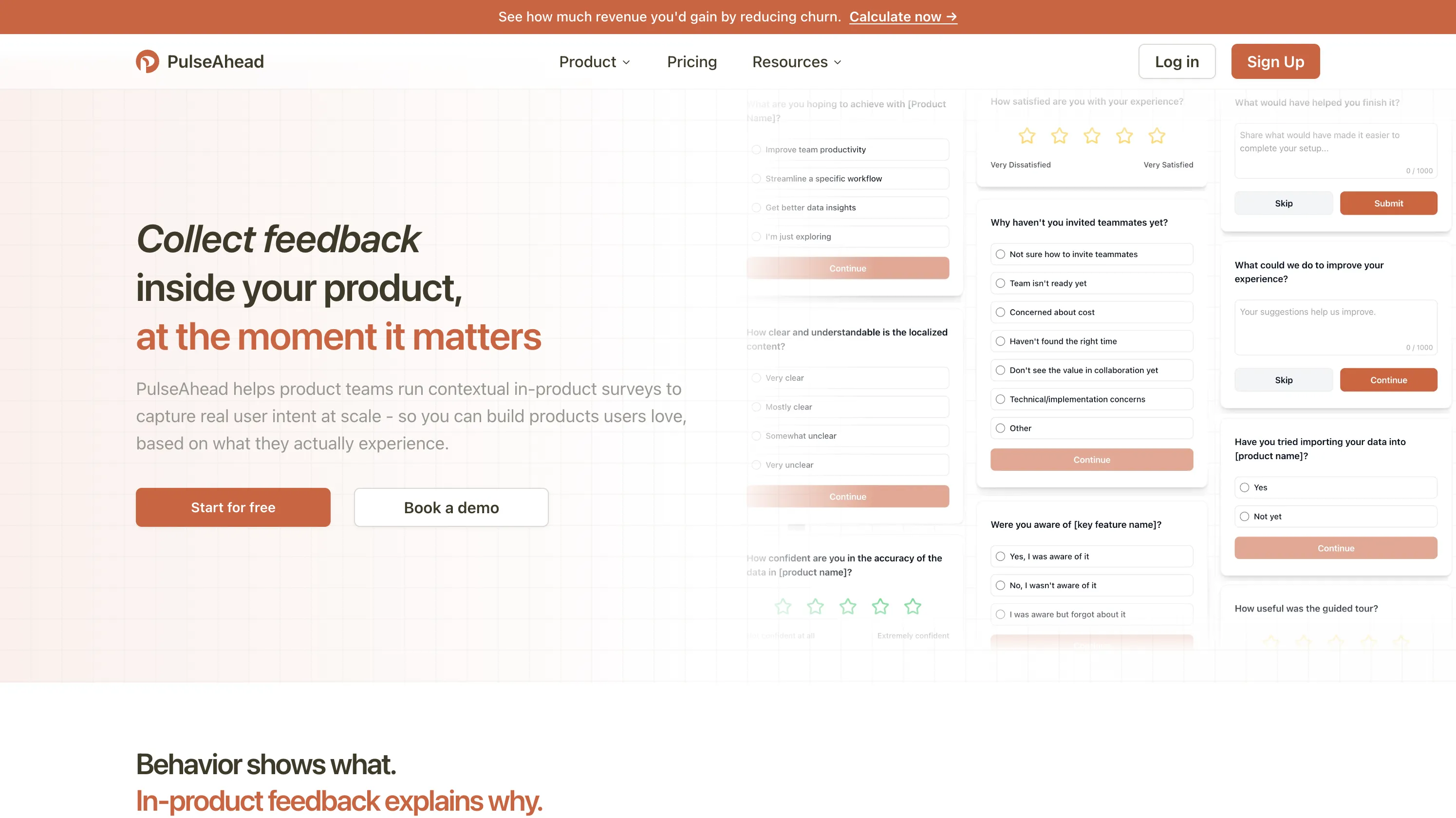
SatisMeter is a focused NPS/CSAT instrument, and that focus is its ceiling. Pulseahead is built for the full arc of SaaS product feedback: onboarding, activation, PMF, NPS, churn, and user profile feedback. The bigger differentiator is not a broader list, it is that these surveys can go live together as a system, with shared setup and a pre-built dashboard. The pricing model is flat with generous response limits: the opposite of a per-response meter.
What Pulseahead does well:
- Full lifecycle coverage: Onboarding, activation, PMF, NPS, churn risk, and user profile feedback can run from the same platform. SatisMeter’s four templates handle NPS and CSAT. Beyond that, teams are building from scratch without a structured SaaS lifecycle starting point.
- Flat pricing with generous limits: Core at $48/month includes 5,000 responses/month across up to 10 active surveys. SatisMeter’s Growth plan is $199/month for 1,000 responses. If you’re running surveys at multiple lifecycle stages, SatisMeter’s cap fills faster than expected.
- Behavioral targeting engine: Trigger surveys by days since signup, session count, URL visited, device, country, or user attributes like plan tier, role, and company size. Chain multiple conditions to target a specific cohort at a specific moment in the product.
- User identification: Responses are tied to user IDs so survey data connects back to your product analytics. Understanding NPS by plan tier or churn risk by onboarding cohort requires that linkage; anonymous response pools don’t give you that signal.
- Anti-fatigue controls: Global survey cooldown and per-survey bypass settings let you manage the pacing of your entire survey program from one place. Users don’t get hit with back-to-back surveys as you scale up the number of active surveys.
- SaaS Survey Pack: Six pre-configured lifecycle surveys with trigger logic already built in. If you want to go from signup to a live in-product survey in under 10 minutes, the Survey Pack is the fastest path.
What Pulseahead doesn’t do:
Pulseahead is web and mobile web only. No native iOS or Android SDKs. If your SaaS product is a native mobile app, that’s a real constraint; SatisMeter covers iOS and Android natively. Pulseahead also doesn’t do email or link surveys; everything runs inside the product.
Worth it if you’re a SaaS product team that needs a ready-made feedback system rather than just a monthly NPS pulse. At $48/month for 5,000 responses versus $199/month for 1,000, the economics change meaningfully as survey volume grows.
Try Pulseahead free and run your first in-product lifecycle survey in under 10 minutes.
2. Refiner: Best for Deep Segmentation and CDP-Connected Stacks
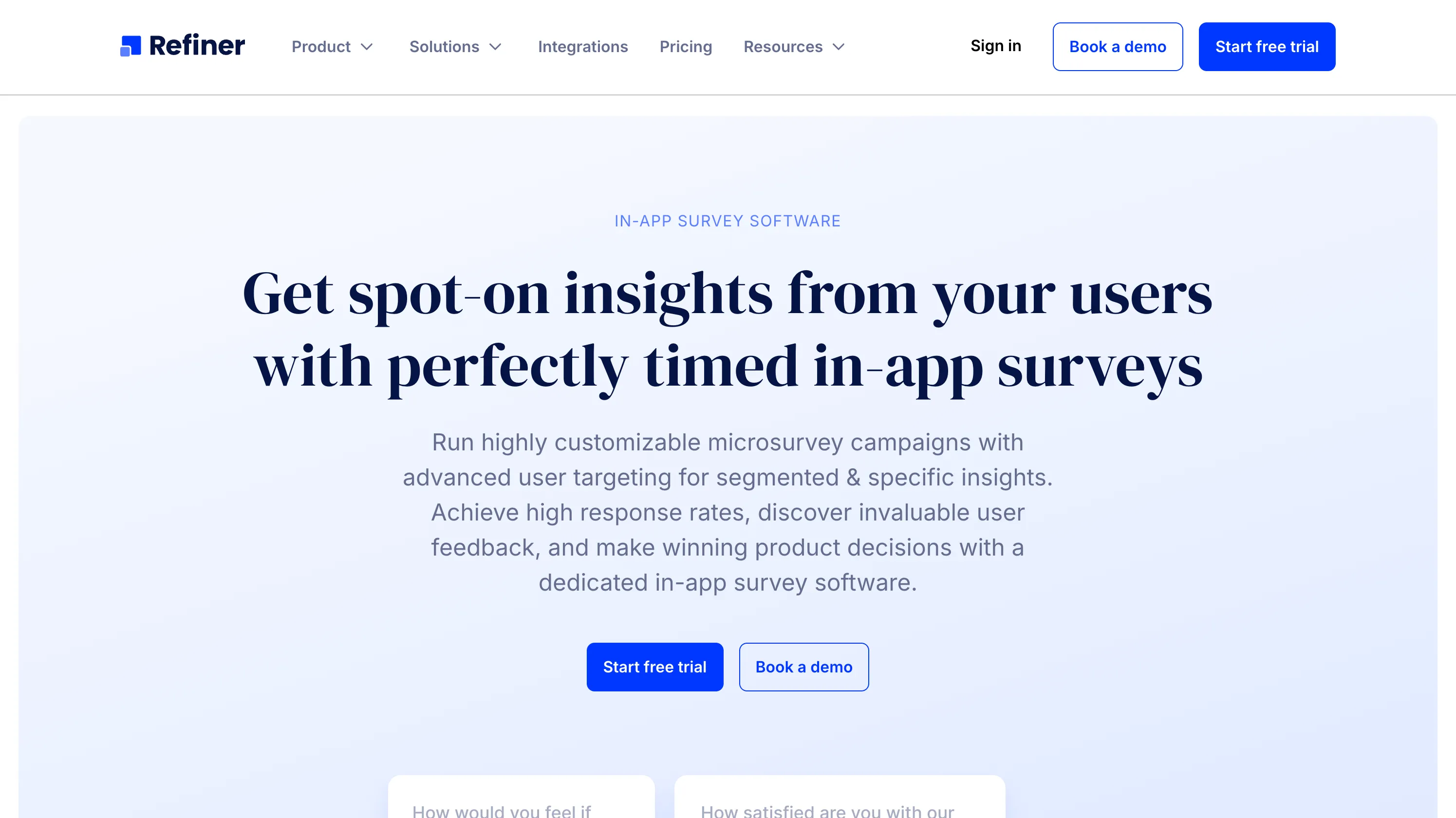
Refiner is the most direct in-product alternative to SatisMeter in this list. Both are built for microsurveys in SaaS web products; Refiner goes deeper on question types, reporting, and integration coverage. Third-party comparison sources that specifically benchmark Refiner against SatisMeter cite better reporting filters, more question types, and stronger Segment integration as the reasons teams switched.
What Refiner does well:
- Proper survey builder: Refiner supports NPS, CSAT, CES, PMF, open-text, multiple choice, and rating scales with full branching logic and a multi-step survey builder. SatisMeter supports similar question types but the builder is basic, with no template library and limited configurability.
- Broader native mobile coverage: iOS, Android, React Native, and Flutter. SatisMeter covers iOS and Android; Refiner extends that to React Native and Flutter with comparable feature parity across all four platforms.
- CDP and analytics integrations: Deep connections with Segment and RudderStack for CDP-driven targeting, plus Amplitude, Mixpanel, HubSpot, and Salesforce. SatisMeter’s Segment integration has documented gaps, flagged by third-party reviewers as incomplete.
- Advanced reporting: Response filtering by user attributes, AI-based response tagging, and consolidated CSV export. SatisMeter’s dashboard is pretty basic with missing essential reporting filters.
What Refiner doesn’t do:
Refiner’s pricing is based on monthly active users (MAUs), which creates a growth penalty for freemium SaaS teams. A company with 50,000 MAUs pays for that entire audience whether 5% or 50% ever sees a survey. The Essentials plan starts at $99/month for 5,000 MAUs, then climbs to $199/month at 50,000 MAUs, the same price as SatisMeter’s Growth plan, but indexed to audience size rather than responses collected. Teams with fast-growing user bases should model the MAU trajectory before committing. See Refiner pricing for more details.
The honest take: Refiner is the right move for SaaS teams with a defined user base under 25,000 MAUs who need more question types, better reporting, and deeper CDP integration than SatisMeter provides.
If response volume is your primary SatisMeter frustration, the next option addresses that more directly.
3. Qualaroo: Best for Teams That Want Unlimited Responses at a Lower Starting Price
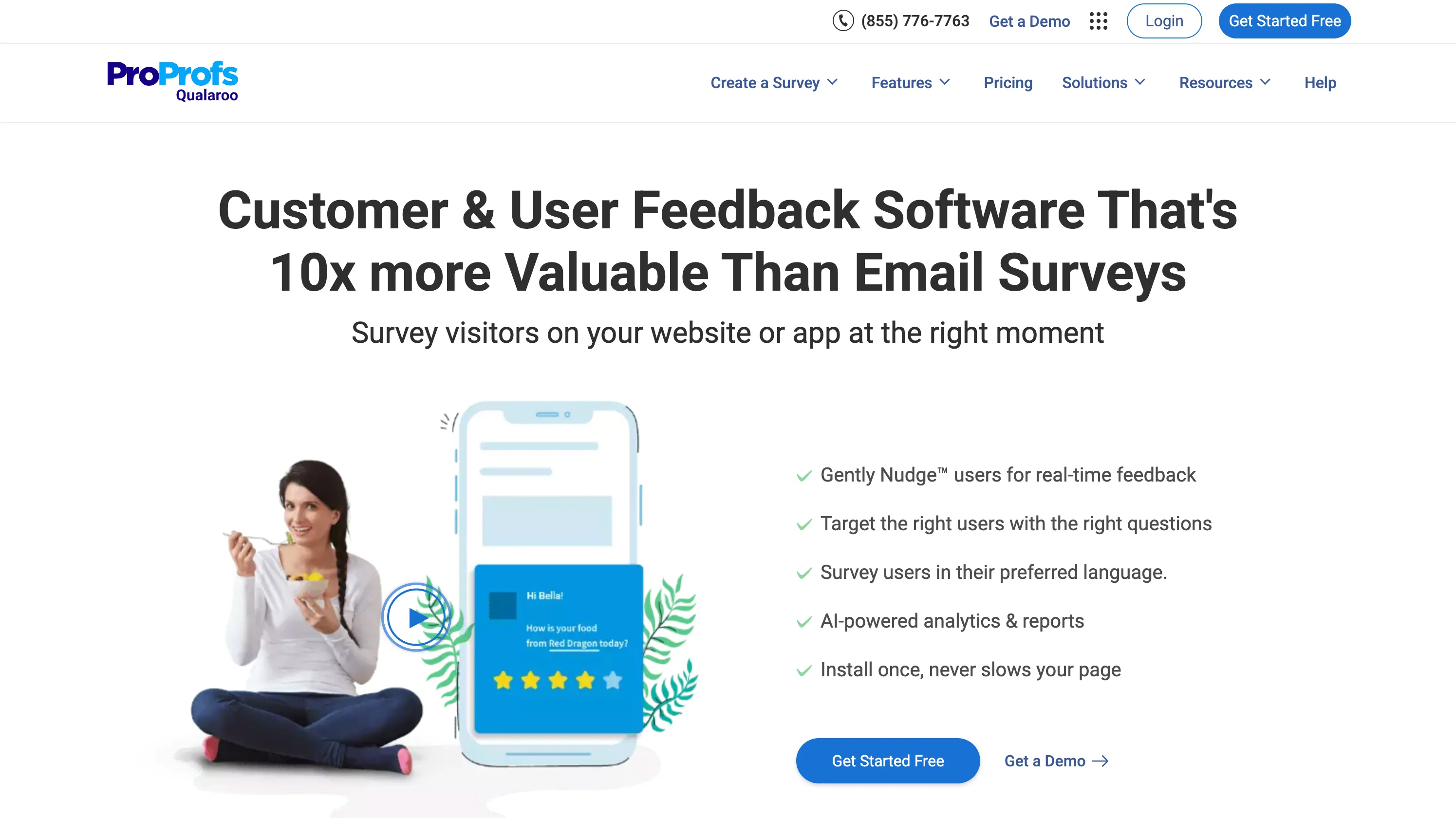
Qualaroo is a decade-old survey tool often highlighted for unlimited-response pricing. The catch: the entry Essentials plan at $39.99/month is email-only. You can’t run in-product surveys on that plan, and question wording is locked to ready-made defaults with no modification allowed. In-product delivery and custom question editing unlock on the Business plan at $69.99/month, which also includes basic targeting and data export. SatisMeter charges $199/month for 1,000 responses.
What Qualaroo does well:
- Unlimited responses on the Business plan: Qualaroo’s Business plan at $69.99/month removes the response ceiling entirely. If SatisMeter’s 1,000-response cap at $199/month is the core pain point, Qualaroo resolves it at a lower price.
- AI-assisted survey creation: Qualaroo includes AI survey generation. SatisMeter has no AI features.
- Branching and skip logic: Conditional question flows let you build more dynamic surveys than SatisMeter’s basic survey builder.
- Lead scoring: Assign scores to answers for lead qualification and display custom results based on total scores. SatisMeter has no equivalent.
What Qualaroo doesn’t do:
The Essentials plan ($39.99/month) is the most important limitation to understand: it supports email surveys only, with no in-product delivery and no ability to edit question text. If you’re switching from SatisMeter specifically because you need in-product surveys, the Essentials plan won’t work for you. The Business plan at $69.99/month is the minimum for in-product delivery. Advanced targeting (event-based triggers, custom user attributes) requires the Enterprise plan at $149.99/month. Branding removal costs an additional $30/month on top of any plan.
Where this fits: Qualaroo’s Essentials plan is a fit if you primarily run email-based NPS or CSAT programs and want unlimited responses at a low price. For in-product survey delivery, you need the Business plan at $69.99/month. If behavioral targeting and in-product triggering are the priority, Pulseahead covers that ground more directly.
4. Survicate: Best for Teams Building Multichannel Feedback Programs
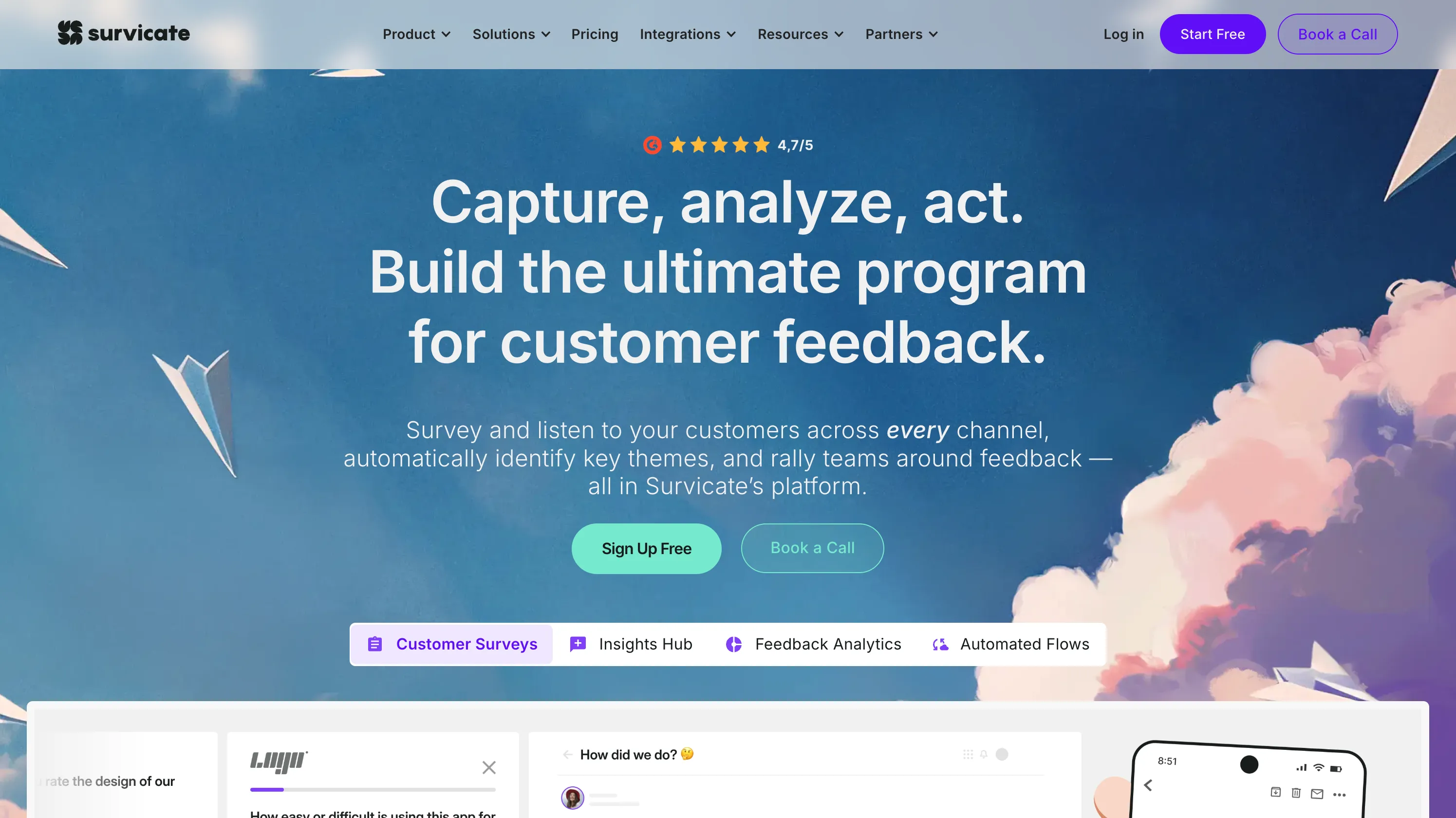
Survicate covers considerably more ground than SatisMeter. Where SatisMeter ships four templates across in-app and email, Survicate handles website, in-product, mobile app, email, and link surveys with 400+ templates and an AI-powered Insights Hub that aggregates feedback across sources. The scope is different enough that Survicate isn’t just a SatisMeter replacement. It’s a step up in platform breadth.
What Survicate does well:
- 400+ survey templates: Template breadth alone is a meaningful unlock for teams that want more than NPS and CSAT. Survicate covers onboarding, PMF, feature research, and specialized survey formats that SatisMeter doesn’t ship.
- AI-powered Insights Hub: Automatically categorizes feedback from surveys, support tickets, reviews, and emails. Identifies feature requests, complaints, and testimonials with sentiment tagging, with more analytics depth than SatisMeter’s basic dashboard.
- Multichannel delivery: Website, in-product, mobile app (iOS/Android), email, and shareable link surveys from one platform. SatisMeter handles in-app and email; Survicate covers every channel.
- Automated workflows: Trigger follow-ups, route feedback to teams, and build event-based sequences. SatisMeter’s automation layer is described by comparison sources as limited relative to tools in this category.
What Survicate doesn’t do:
Survicate’s response-based pricing escalates quickly. The Starter plan at $89/month includes only 100 responses. A team running light onboarding and NPS surveys can hit that in one week. At 500 responses/month the cost jumps to $279/month. Event-based targeting and JavaScript API control are gated behind the Pro plan, which starts at $349/month on an annual commitment. If you’re comparing to SatisMeter’s $199/month for 1,000 responses, Survicate’s cost at meaningful volume can exceed that.
If you’re looking to avoid these pricing ceilings and feature gates, see our detailed guide on how to choose the right Survicate alternative.
What you’re choosing: Survicate if your SaaS team wants the broadest template library, multichannel delivery, and AI-powered insight aggregation, and can budget for per-response pricing that scales with survey volume.
5. Hotjar: Best for SaaS Teams That Want Behavior Analytics Alongside Surveys
Hotjar is a behavior analytics platform, not a survey-first tool. Heatmaps and session recordings are the core product; surveys sit alongside them as a feedback module. If your team is already using behavior analytics and paying for SatisMeter separately, Hotjar is worth evaluating as a consolidation option rather than a like-for-like replacement.
What Hotjar does well:
- Session recordings, heatmaps, and surveys in one: If you’re already paying for a behavior analytics tool and SatisMeter separately, Hotjar reduces that to one subscription. Whether the bundled cost is lower depends on your response volume.
- AI sentiment analysis: Hotjar’s AI automatically categorizes open-text survey responses as positive, neutral, or negative, and surfaces recurring topics. SatisMeter has no text analysis.
- Attribute-based survey targeting: The Growth plan supports targeting surveys to users matching specific attributes, comparable to SatisMeter’s attribute and event triggering.
- User research tooling: Beyond surveys, Hotjar includes scheduling and hosting for user interviews. Useful for product teams doing qualitative research alongside NPS/CSAT.
What Hotjar doesn’t do:
Hotjar’s surveys are a supporting feature inside a behavior analytics product. The Growth plan costs $99/month for 500 responses; at 1,000 responses you’re at $129/month, slightly cheaper than SatisMeter for the same volume, but in a tool where surveys aren’t the primary focus. For teams that specifically need lifecycle survey coverage with deep behavioral triggering, a dedicated survey platform will serve better than a bundled analytics suite. Response export is Pro-plan only.
Worth it if your team genuinely uses heatmaps and session recordings and wants to add surveys without introducing another tool. If you’re only evaluating for surveys, you’re paying for analytics capabilities you won’t use.
The Template Ceiling That Catches Growing SaaS Teams
Tools optimized for “simple and fast” tend to stay simple. That’s a feature for teams that need a quick NPS pulse and nothing else. It becomes a limitation when the feedback program needs to grow alongside the product.
The pattern with SatisMeter is consistent across third-party reviews: teams install it for NPS, it runs quietly for a year, and then the product evolves to a point where a single metric isn’t enough. Onboarding breaks. A feature ships without adoption. Renewal rates dip. Each of those moments needs a different survey, triggered at a different point in the user journey, connected to the right behavioral signal.
Four templates don’t stretch to cover that. And 1,000 responses don’t leave much room for parallel programs. The tools that serve SaaS feedback programs over time are built around the product lifecycle, not just the quarterly pulse use case.
SatisMeter’s acquisition by Productboard adds another variable. The standalone tool still operates, but teams building multi-year feedback programs reasonably factor roadmap continuity into their vendor decisions.
How to Choose the Right SatisMeter Alternative
Start with why you’re leaving, not what features you want.
If the 1,000-response cap is the problem: Pulseahead ($48/month, 5,000 responses/month with in-product delivery) or Qualaroo Business ($69.99/month, unlimited responses with in-product delivery) both outpace SatisMeter’s cap. Pulseahead also gives you more flexible in-product targeting and a faster packaged setup; Qualaroo Business is an option if your targeting needs are basic.
If four survey templates aren’t enough: Pulseahead supports custom surveys alongside pre-built lifecycle templates for onboarding, activation, PMF, NPS, churn, and user profile feedback. Survicate goes wider with 400+ templates and adds email and link surveys SatisMeter doesn’t cover.
If the reporting feels too basic: Refiner offers response filtering by user attributes, AI-based tagging, and proper CDP integrations with Segment, Amplitude, and Mixpanel — the gaps third-party reviewers most commonly cite when leaving SatisMeter.
If you’re already paying for behavior analytics: Hotjar combines heatmaps, session recordings, and surveys in one subscription. Not the deepest survey platform, but worth evaluating if you’re paying for Hotjar separately and running basic NPS/CSAT.
Staying on SatisMeter: It’s still a good fit for teams running a simple quarterly NPS or CSAT pulse with no need for lifecycle coverage. Factor in the Productboard acquisition if you’re planning multi-year.
Bottom Line
SatisMeter does its core job cleanly. The limitation isn’t quality; it’s scope. Four survey types and 1,000 responses serve a specific use case well. When the product grows and the feedback program needs to grow with it, that scope becomes the ceiling.
For SaaS product teams that want to survey users at every stage of the lifecycle, not just the scheduled NPS pulse, the calculus shifts. Flat pricing, lifecycle coverage, and practical in-product targeting built for in-product feedback make that transition straightforward.
Ask yourself: are you running surveys at the moments when users are actually forming opinions about your product, or scheduling them after the fact? The tools built for the first question are different from the ones built for the second.
Try Pulseahead free and run your first in-product survey in under 10 minutes.
Frequently Asked Questions
Is SatisMeter worth it for SaaS teams?
SatisMeter works well for SaaS teams that need a monthly NPS or CSAT pulse with minimal setup. If your feedback program is expanding beyond those four template types, or if 1,000 responses per month is becoming a constraint, the $199/month Growth plan's value diminishes quickly relative to alternatives.
What happened to SatisMeter after the Productboard acquisition?
SatisMeter was acquired by Productboard, a product management platform. The standalone product continues to operate. Teams planning a multi-year feedback program reasonably factor roadmap continuity into their decision. Whether Productboard maintains SatisMeter as an independent product or rolls it into the Productboard suite is an open question.
Which SatisMeter alternative is cheapest?
Qualaroo Essentials at $39.99/month is the lowest price point, but it's limited to email surveys only with no in-product delivery and no question customization. Pulseahead Core at $48/month includes 5,000 responses/month across up to 10 active surveys with full in-product delivery. Qualaroo Business at $69.99/month offers unlimited responses including in-product surveys. All three are substantially cheaper than SatisMeter's $199/month Growth plan for 1,000 responses.
What survey types does SatisMeter support?
SatisMeter supports NPS, CSAT, CES, and PMF as built-in templates. Custom micro-surveys are possible but the template library is limited compared to alternatives like Survicate (400+ templates) or Refiner (12+ question types with full branching logic).
Does SatisMeter have a free plan?
SatisMeter's free plan allows 25 responses per month. That's enough to verify the integration works, but not enough to run a meaningful survey program. Pulseahead's free plan includes 100 responses and 2 active surveys. Qualaroo's free plan includes 50 responses.
Which SatisMeter alternative has the best in-product targeting?
Refiner offers the deepest targeting for integration-heavy stacks (Segment, RudderStack, Amplitude, Mixpanel, HubSpot, Salesforce). Pulseahead provides strong in-product targeting through session count, days since signup, URL, device, country, and user attributes, with flat pricing and generous monthly limits. Both outperform SatisMeter's targeting depth.
Can I get mobile app survey coverage switching from SatisMeter?
SatisMeter supports iOS and Android via SDKs. Of the alternatives listed, Refiner also covers iOS, Android, React Native, and Flutter with native SDKs. Survicate supports mobile app surveys as well. Pulseahead is web and mobile web only. No native mobile SDKs.