

If you’re looking for Qualaroo alternatives or direct Qualaroo competitors, you are usually reacting to the same thing: an in-product survey tool that still makes more sense on paper than it does once your product starts growing. Qualaroo pioneered the “Nudge” format. A small, non-intrusive widget that fires inside your product, asks one question, and disappears. For its time, it was a genuinely clever idea.
The friction shows up fast. First, billing is pageview-based. The Business plan at $69.99/month caps you at 100,000 pageviews. A high-traffic SaaS product can burn through that in days. Crossing the cap means jumping to the Enterprise tier at $149.99/month, billed annually with no monthly option. And if you want to remove the “Powered by Qualaroo” badge from your surveys, that is a separate $30/month surcharge on top of whichever plan you are on. Second, native iOS and Android SDKs are gated behind the Enterprise tier. If you are on Business and your product has a mobile component, you are doing mobile research without native SDK support.
Here are 9 Qualaroo alternatives and competitors evaluated on pricing model, mobile SDK support, targeting flexibility, usability for SaaS product teams, and whether the free plan is actually usable.
Quick Comparison
| Tool | Best For | Starting Price | Pricing Model | Free Plan |
|---|---|---|---|---|
| Pulseahead | In-product surveys with flat pricing and no growth taxes | $48/month | Flat rate, response pools | Yes (100 responses) |
| Refiner | SaaS targeting precision with native mobile SDKs | $99/month | Monthly active user (MAU) tiers | Yes (25 responses) |
| Survicate | Multi-channel feedback with AI-powered analysis | $89/month | Response-based, expensive at scale | Yes (25 responses) |
| SatisMeter | Simple NPS and CSAT at a transparent price | $199/month | Response + active user tiers | Yes (25 responses) |
| Iterate | Native mobile app surveys without enterprise gating | Custom (MAU-based) | MAU-based custom plan | Yes (14-day trial) |
| Hotjar | UX teams wanting behavioral context alongside surveys | $99/month | Response-based, scales by volume | Yes (100 responses) |
| Blitzllama | AI-powered qualitative analysis at high volume | $100/month | MAU-based | Yes (500 responses) |
| Pendo | Enterprise SaaS needing analytics, guides, and surveys together | Custom | Custom enterprise | Yes (500 MAU, NPS only) |
| Zonka Feedback | Large enterprises requiring omnichannel CX intelligence | Custom | Custom enterprise | No (demo required) |
1. Pulseahead: Best for Flat-Priced In-Product Surveys Without Growth Penalties
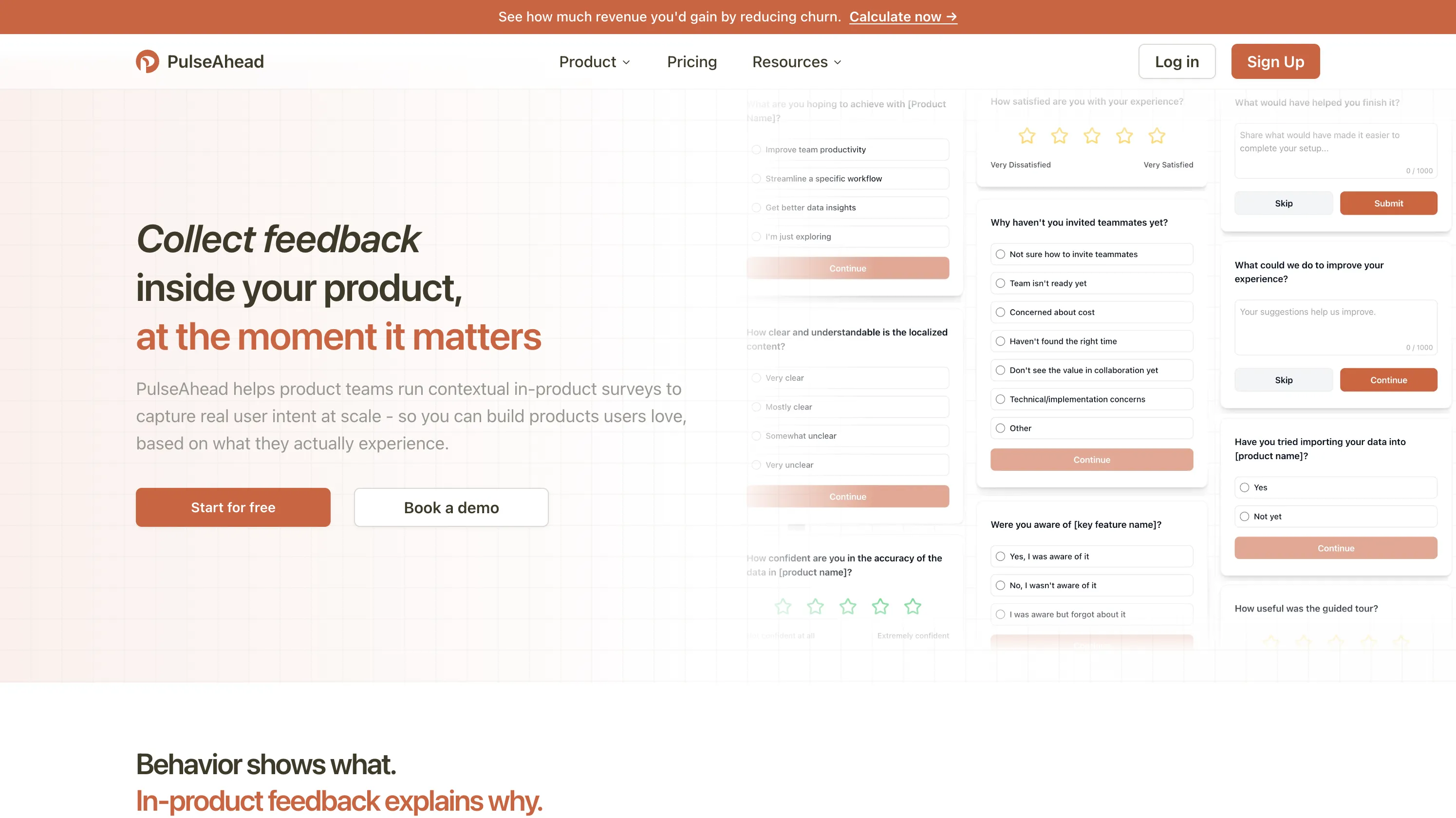
You are likely leaving Qualaroo because your product is growing and your survey bill is growing with it, not because you are running more research, but because you are collecting more pageviews. Pulseahead inverts that model. Our flat rate pricing means your bill does not change whether you have 5,000 or 500,000 monthly visitors.
What Pulseahead does well:
- No pageview-based billing: Core is $48/month for 5,000 responses. Pro is $108/month for 10,000. No pageview caps, no overage tiers, no surprises at the end of a traffic spike.
- Branding removal is included: Every paid plan removes “Powered by Pulseahead” from your surveys. Qualaroo charges an additional $30/month for the same privilege. With Pulseahead, you are not paying a separate line item to not advertise their product inside yours.
- SaaS-relevant targeting: Trigger surveys by days since signup, session count, user attributes (plan tier, role, company size, custom attributes), URL, country, device, OS, and browser. These are the conditions that matter for targeting users at a specific moment in the product lifecycle.
- User identification: You can identify users via SDK to tie survey responses to specific accounts. Segment by plan tier, onboarding cohort, or any custom attribute you pass at initialization without relying on anonymous session data alone.
- SaaS Survey Pack: Our SaaS Survey Pack includes six pre-configured lifecycle surveys covering user profile, onboarding, activation, Product-Market Fit, NPS, and churn. The real advantage is speed to insight: you can launch the whole pack together, tune the core targeting inputs quickly, and start collecting feedback into a pre-built dashboard in under 10 minutes.
What Pulseahead doesn’t do:
Pulseahead is web and mobile web only. No native iOS or Android SDKs. If your product is primarily a native mobile app, that is a real constraint. Qualaroo’s prototype testing, which lets teams run surveys on non-owned URLs like Figma or InVision prototypes, is also not part of Pulseahead’s feature set.
Worth it if: You are a web-first SaaS team whose survey bill is climbing for reasons disconnected from how much research you are actually doing. Flat pricing with a generous response pool is the structural fix for the structural problem Qualaroo creates.
Try Pulseahead free and run your first in-product survey in under 10 minutes.
2. Refiner: Best for Precise SaaS Targeting with Native Mobile SDKs
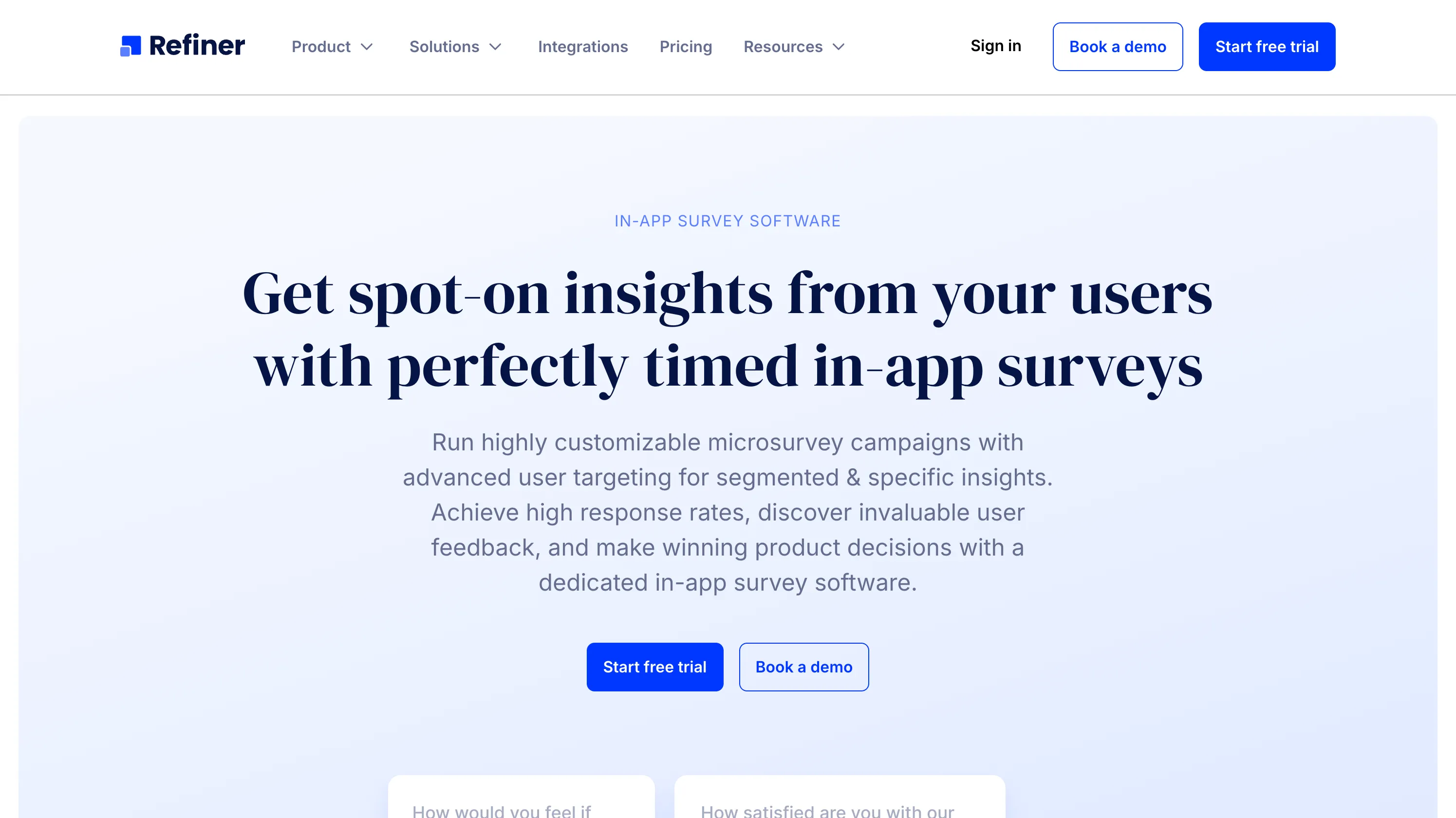
Refiner solves the mobile SDK problem that Qualaroo reserves for its top tier. Native iOS and Android SDKs are available on all paid plans, not locked behind an enterprise contract. It is a direct substitute for Qualaroo’s core in-product microsurvey use case, with more depth in behavioral targeting and first-class mobile support from the start.
Refiner uses monthly active user (MAU) based pricing. The Essentials plan starts at $99/month for 5,000 MAUs, scales to $119/month at 10,000 MAUs, and reaches $149/month at 25,000 MAUs. The Growth tier at $239/month adds CDP integrations and CRM connectors. More transparent than Qualaroo’s pageview-plus-surcharge model, but teams with fast-growing products should model the cost at their expected MAU volume before committing.
What Refiner does well:
- Native mobile SDKs: iOS and Android from the first paid plan. No enterprise contract required.
- Event-based targeting: Trigger surveys on specific user actions, not just page visits. Fine-grained user attribute conditions let you build precise audience rules.
- CDP and CRM integrations: Segment, RudderStack, HubSpot, Amplitude, Mixpanel, and Salesforce on the Growth plan, for teams that need survey data connected to their existing stack.
- Unlimited responses on paid plans: Refiner bills by MAU, not by response volume. Once you are on a paid plan, response caps are not a concern.
- SaaS focus: Built specifically for product teams running microsurveys, not a general-purpose survey tool adapted for in-product use.
What Refiner doesn’t do:
Refiner does not have Qualaroo’s IBM Watson sentiment analysis. Open-text analysis requires handling outside the platform or via a third-party integration. Refiner supports email survey delivery but is optimized for in-product micro-surveys; teams running a multi-channel feedback program across email, link, and native mobile will find Survicate a closer fit. No prototype testing on non-owned URLs.
The honest take: Strong choice for product-led SaaS and mobile app teams who need precise targeting and want mobile research without negotiating an enterprise deal. Watch the MAU tiers as your product scales.
If you want a unified platform that spans in-app, email, link, and native mobile surveys from a single dashboard, the next option is built around that breadth.
3. Survicate: Best for Multi-Channel Feedback with AI Analysis
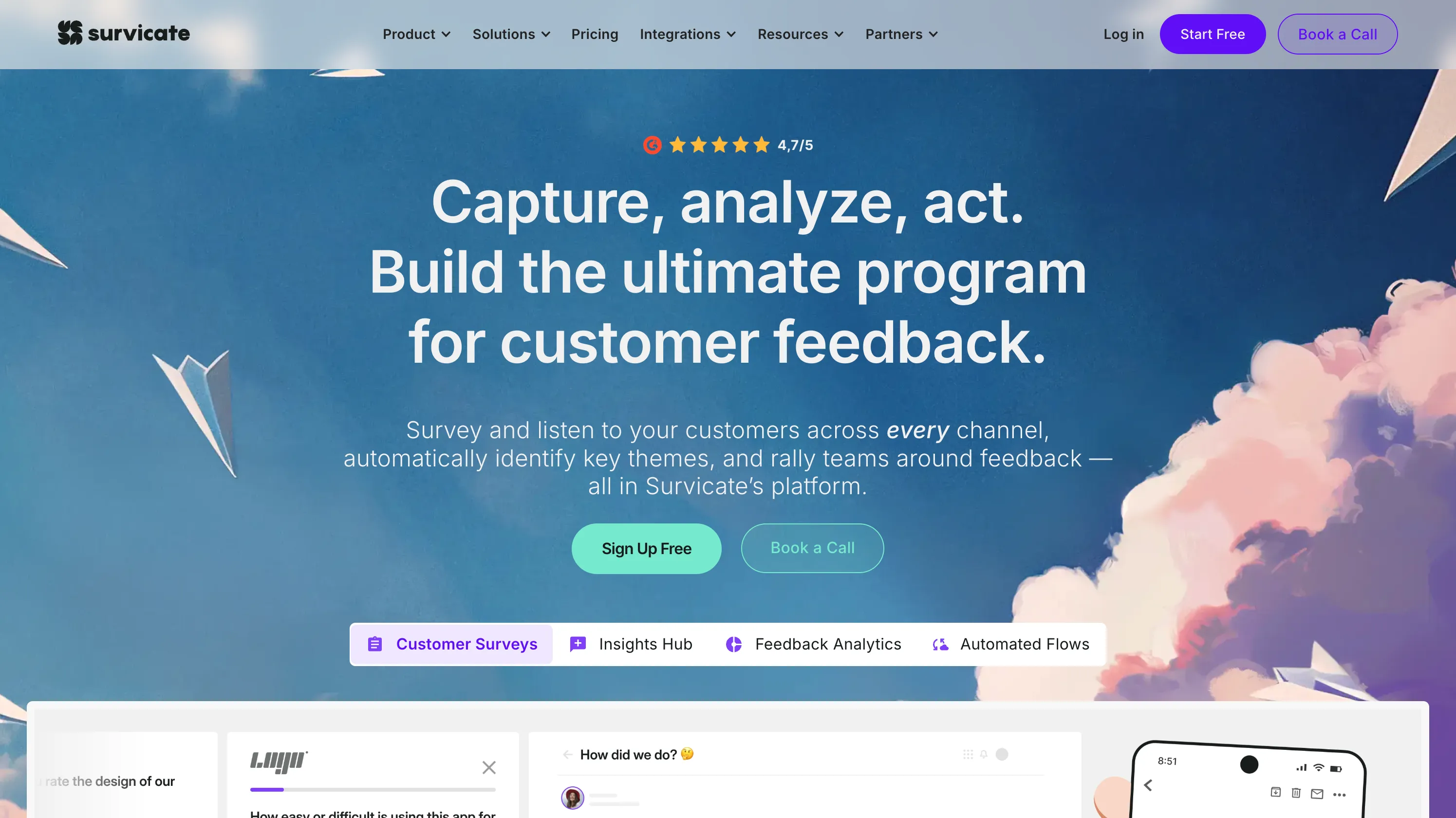
Survicate covers more ground than Qualaroo. Where Qualaroo focuses on the Nudge widget for in-product use, Survicate handles in-app, email, link, and native mobile surveys from a single platform. If your feedback program spans the full customer lifecycle, from in-product pulses to post-onboarding email check-ins, Survicate can consolidate that into one tool.
The Survicate pricing model is where caution is warranted. The Starter plan at $89/month includes only 100 responses, with additional responses charged at $0.89 each. At 1,000 responses per month (a light survey cadence for a growing SaaS product), the effective cost reaches $979/month. Higher-response tiers jump to $179/month for 250 responses and $279/month for 500. For any significant volume, Survicate pushes teams toward custom annual pricing.
What Survicate does well:
- Full multi-channel delivery: In-app, email, link, and native mobile surveys in one platform. Qualaroo’s Nudge is limited to web and app.
- AI-powered Insights Hub: Automatic categorization and thematic clustering of open-text feedback across all channels. More modern than Qualaroo’s IBM Watson integration.
- 400-plus survey templates: Pre-built for common SaaS lifecycle moments and a broad range of use cases.
- Native mobile SDK: iOS and Android support available without enterprise gating.
- HubSpot and CRM integrations: Used by teams at Spotify, Automattic, and Vercel who need feedback data connected to their existing customer records.
What Survicate doesn’t do:
Survicate’s per-response pricing at the entry tier makes it expensive at the volume a growing SaaS product needs. SaaS-specific behavioral triggers are less granular than Refiner or Qualaroo for highly specific conditions. Prototype testing on non-owned URLs is not supported.
Where this fits: Mid-market SaaS and e-commerce teams who need a unified hub across multiple feedback channels and are prepared to commit to annual pricing to make the response economics work.
4. SatisMeter: Best for Simple NPS and CSAT at a Transparent Price
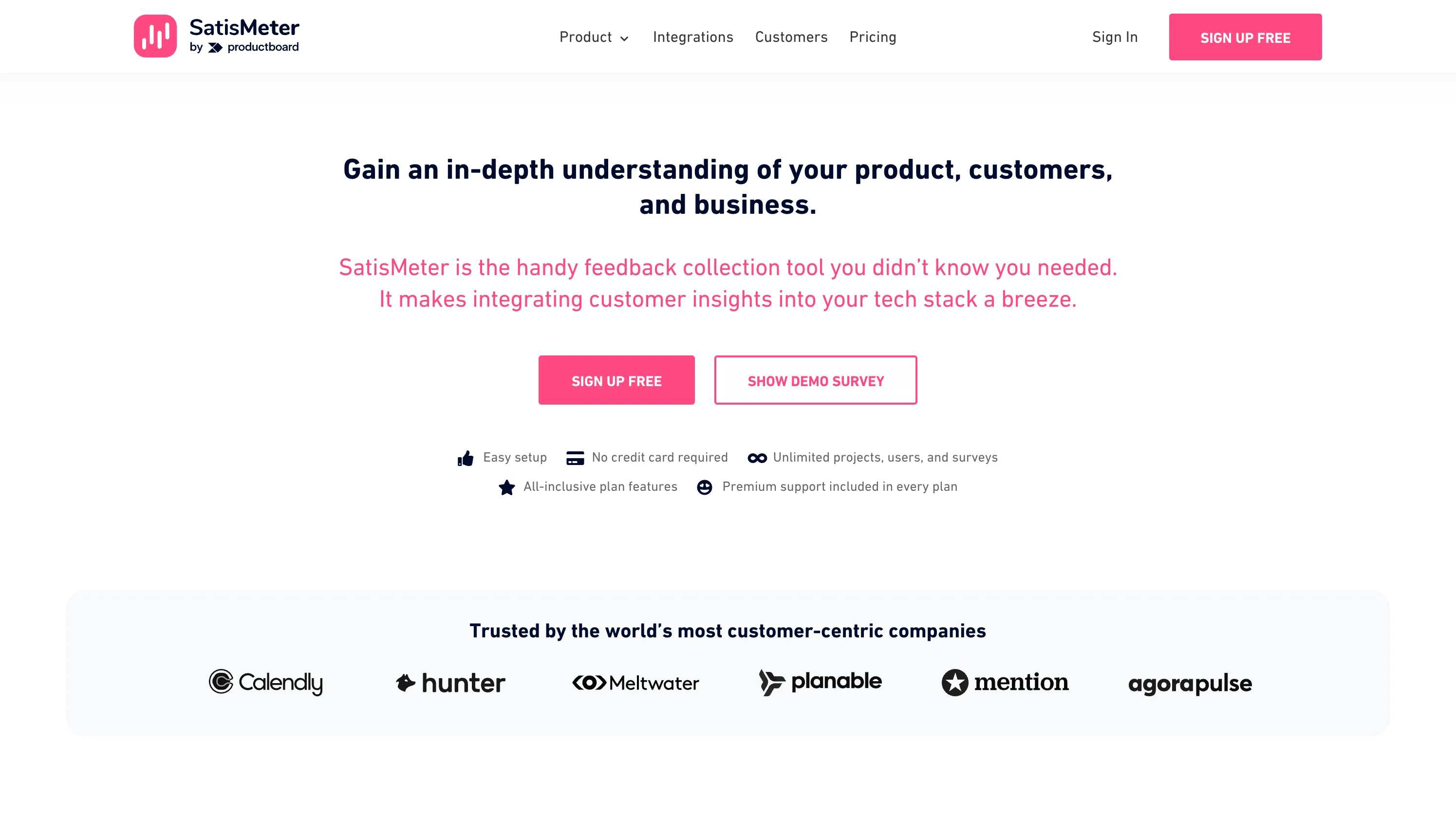
SatisMeter offers what Qualaroo does not: a completely honest pricing structure for standard NPS and CSAT. No pageview caps, no branding surcharges, no mobile SDK gating. The Growth plan is $199/month for 1,000 responses and 10,000 active users, and that is the full price.
SatisMeter was acquired by Productboard. Acquisitions in this category tend to follow a pattern where the standalone tool’s roadmap gradually aligns with the parent platform’s enterprise priorities rather than evolving independently. Teams making a long-term platform decision should factor that trajectory in.
What SatisMeter does well:
- Fast setup: Get Net Promoter Score (NPS) surveys live in under five minutes. No configuration complexity.
- Review driver flows: Built-in prompts to send promoters to G2, Trustpilot, or Capterra immediately after an NPS survey. Useful for SaaS teams that want to convert positive signals into public reviews.
- Transparent, no-surprise pricing: One plan, clear limits, no hidden surcharges.
- No enterprise gating: Core NPS, CSAT, CES, and PMF functionality is available from the first paid plan.
What SatisMeter doesn’t do:
SatisMeter’s survey types are narrow: NPS, CSAT, CES, and PMF. A custom survey builder exists, but the template library does not scaffold the broader lifecycle moments a product team needs. No AI sentiment analysis, no prototype testing, no advanced behavioral triggers beyond basic user properties. At $199/month for 1,000 responses, the per-response cost is $0.20, compared to Pulseahead’s Core at $48/month for 5,000 responses.
What you’re choosing: A simpler, more honest pricing model for standard sentiment metrics. If you need the survey breadth or targeting depth Qualaroo provides, SatisMeter will fall short quickly. For more options, see our SatisMeter alternatives guide.
The next option takes a fundamentally different approach, building surveys from mobile-first rather than web-first.
5. Iterate: Best for Native Mobile App Teams
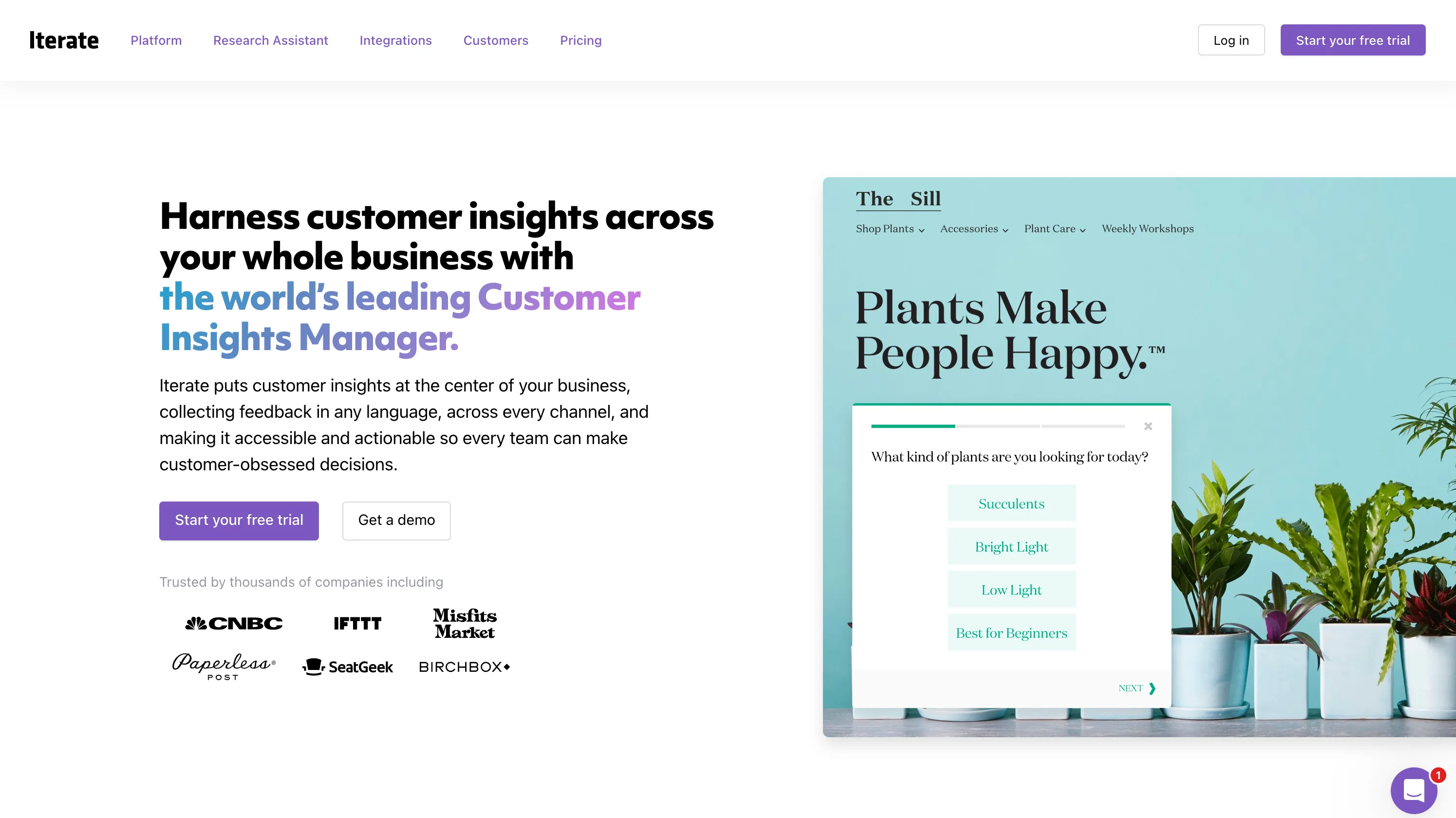
Iterate was built for mobile environments from the start. Native iOS and Android SDKs are the core product, not an enterprise add-on. If your SaaS product is primarily a native mobile app, or if a significant portion of your users are on mobile and you have been blocked from Qualaroo’s SDK without an enterprise contract, Iterate handles that distribution channel directly.
Pricing is MAU-based with a custom plan builder. You choose the combination of monthly active users, email sends, and premium integrations that fits your needs. Entry pricing at low MAU volumes is competitive, but model the cost at your actual MAU count before committing.
What Iterate does well:
- Mobile-native SDK: Purpose-built for iOS and Android app environments, not adapted from a web survey platform.
- Event-triggered surveys: Fires based on specific in-app events, giving product teams precise control over which user actions prompt a question.
- Email surveys: Iterate covers email-based distribution alongside in-app, charged separately based on sends.
- Unlimited responses on paid plans: No response cap once you are on a paid tier; billing is by MAU.
What Iterate doesn’t do:
Iterate’s analytics are lightweight. No AI text analysis, no deep cross-tab reporting, and no trend dashboards comparable to Qualaroo’s. Web-specific targeting capabilities like regex URL matching and subdomain targeting are more mature in Qualaroo than Iterate. If your primary research surface is a web application with occasional mobile use, Iterate may not be the right fit.
Worth it if: Your product is predominantly a native mobile app and Qualaroo’s Enterprise-only SDK gating is the primary reason you’re evaluating alternatives. For web-first teams, other options on this list are a closer match.
6. Hotjar: Best for Connecting Survey Data with Behavioral Context
Hotjar is the only tool on this list where surveys are explicitly a secondary module. The core product is heatmaps, session recordings, and behavioral analytics. Surveys exist to help you attach a “why” to the behavioral data you are already collecting.
Hotjar was acquired by Contentsquare in 2021. Contentsquare raised $500M at a $2.8B valuation and is expanding aggressively into enterprise Digital Experience Analytics. The practical implication: Hotjar’s roadmap is increasingly shaped by enterprise CX needs, not the SaaS product manager who wants a focused in-product NPS widget.
What Hotjar does well:
- Behavioral context: See heatmaps and session recordings from the same users who answered your survey. The combination is genuinely useful for conversion and UX research.
- On-page triggers: Fire surveys based on exit intent, time-on-page, or specific page URLs.
- Low barrier to entry: Free plan includes 100 responses and 3 surveys. Paid Growth starts at $99/month for 500 responses.
- Large integration ecosystem: Google Analytics, HubSpot, Slack, and a range of analytics tools.
What Hotjar doesn’t do:
Hotjar’s survey logic is shallow compared to Qualaroo. Branching based on previous answers, behavioral triggers using SaaS-specific attributes like days since signup or session count, and fine-grained user segmentation are limited or absent. Scaling responses beyond 500/month pushes the cost up quickly: 1,000 responses/month is $129/month, and 2,500 responses/month is $249/month. For a SaaS team that just needs in-product surveys, you are paying for a visual analytics suite to get a survey widget.
The honest take: Right choice if you genuinely need session recordings and heatmaps alongside surveys. If surveys are your primary goal and behavioral analytics is secondary, you are paying for a bundle that shapes the product in a direction away from survey depth.
7. Blitzllama: Best for AI-Powered Qualitative Analysis at Volume
Blitzllama was built as a direct response to the dated IBM Watson sentiment engine that Qualaroo ships. Where Qualaroo runs open-text responses through Watson’s NLP for basic positive/negative classification and word clouds, Blitzllama applies GPT-powered categorization, topic clustering, and actionable recommendations on top of survey responses.
Blitzllama was acquired by Wingify in 2025 (which was itself acquired by Everstone Capital), and their website now states the platform will be merged into the VWO product suite. Teams evaluating Blitzllama for a long-term commitment should factor that trajectory into their decision.
What Blitzllama does well:
- GPT-powered text analysis: Automatic topic clustering and theme extraction from open-text responses. More modern and actionable than Watson-based sentiment tagging.
- Generous free tier: 500 monthly responses and 5,000 monthly tracked users at no cost, which is higher than most competitors at the free level.
- Native mobile SDKs: iOS and Android support on paid plans without enterprise gating.
- In-product and link surveys: Covers both in-app delivery and shareable link distribution.
What Blitzllama doesn’t do:
Blitzllama’s native integration list is narrower than Qualaroo’s established ecosystem. The acquisition roadmap adds genuine uncertainty for teams making a multi-year platform decision. As the product moves toward VWO integration, standalone survey development may slow. This is the tool that most directly replaces Qualaroo’s AI analysis, but the timing of the merger creates a risk factor worth naming.
Where this fits: Product-led growth teams running high volumes of open-ended surveys who want more from qualitative analysis than word clouds, and are comfortable with some platform uncertainty in exchange for more modern AI tooling.
8. Pendo: Best for Enterprise SaaS Needing Analytics, Guides, and Surveys Together
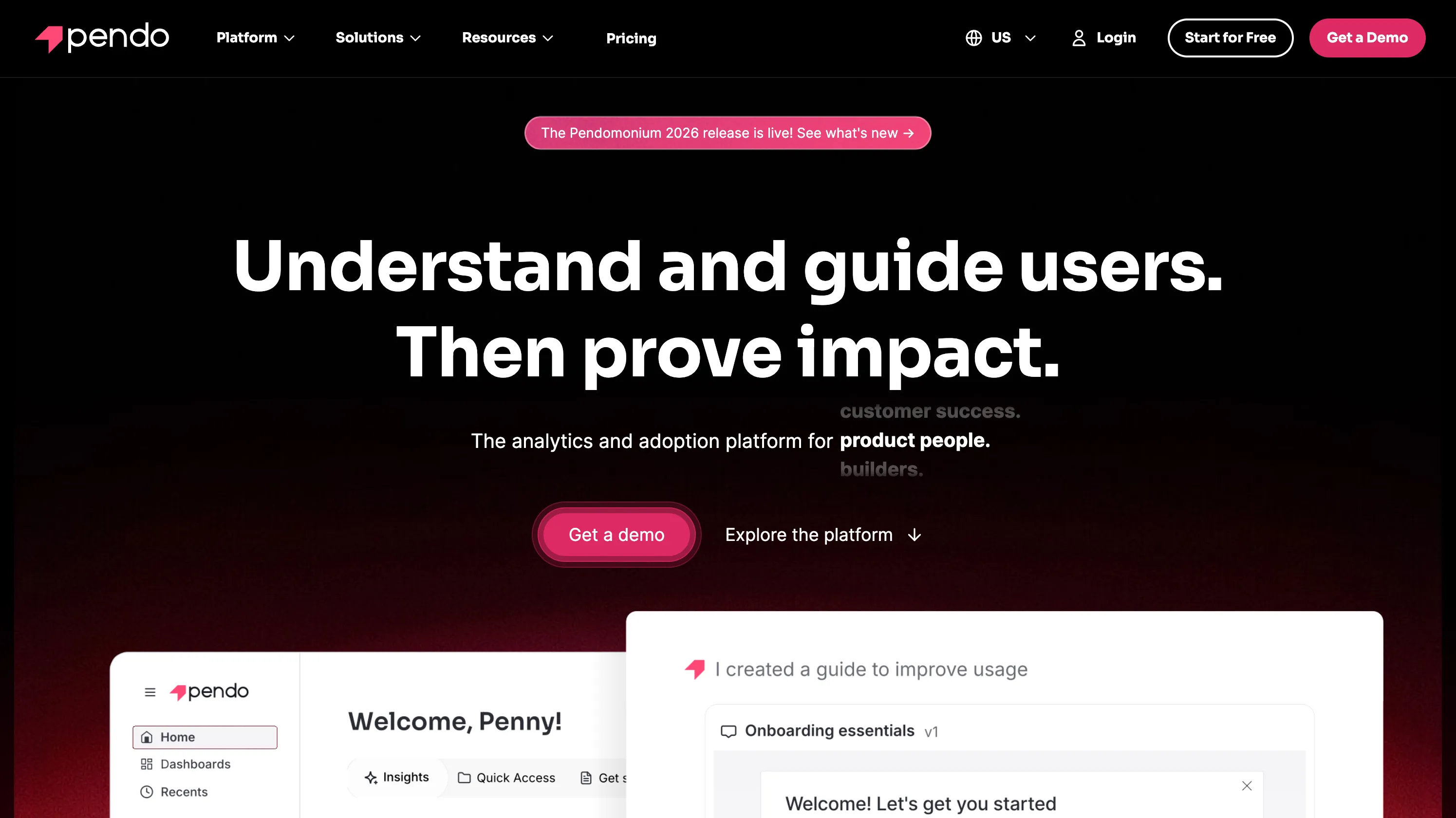
Pendo is not a survey tool with product analytics bolted on. It is a product experience platform where surveys are one module alongside product analytics, in-app guides, onboarding flows, and roadmapping. If your team needs all of that from a single vendor, Pendo is a legitimate answer. If surveys are your primary need, you are paying for a significant platform to get one widget.
All paid plans at Pendo are custom-quoted. The free tier exists and includes 500 monthly active users (MAUs) with branded NPS surveys only. Getting beyond free means a sales conversation and enterprise-level pricing expectations. Implementation requires meaningful developer time for SDK instrumentation and event tagging before surveys can be configured.
What Pendo does well:
- Integrated product analytics: Usage data and survey responses in one platform. You can see which features a user has engaged with, then target surveys to that specific cohort.
- In-app guides alongside surveys: Build onboarding flows and collect feedback in the same tool. No separate survey platform to stitch together.
- Enterprise governance: SSO, role-based access control, audit logs, and compliance features for organizations that need them.
- Roadmapping connection: Route NPS promoter feedback into feature request boards without manual process.
What Pendo doesn’t do:
Pendo’s survey module is not the product’s focus. Compared to dedicated survey tools, the builder has fewer question types, less targeting granularity at the individual survey level, and survey creation is secondary to the analytics and guide builders in the interface. Setup is measured in weeks, not minutes.
Worth it if: Your team is already budgeting for a product analytics and onboarding platform and surveys are one of several capabilities you need from a unified vendor. Not worth it if surveys are your primary need and you want something live within days.
9. Zonka Feedback: Best for Omnichannel Enterprise CX Programs
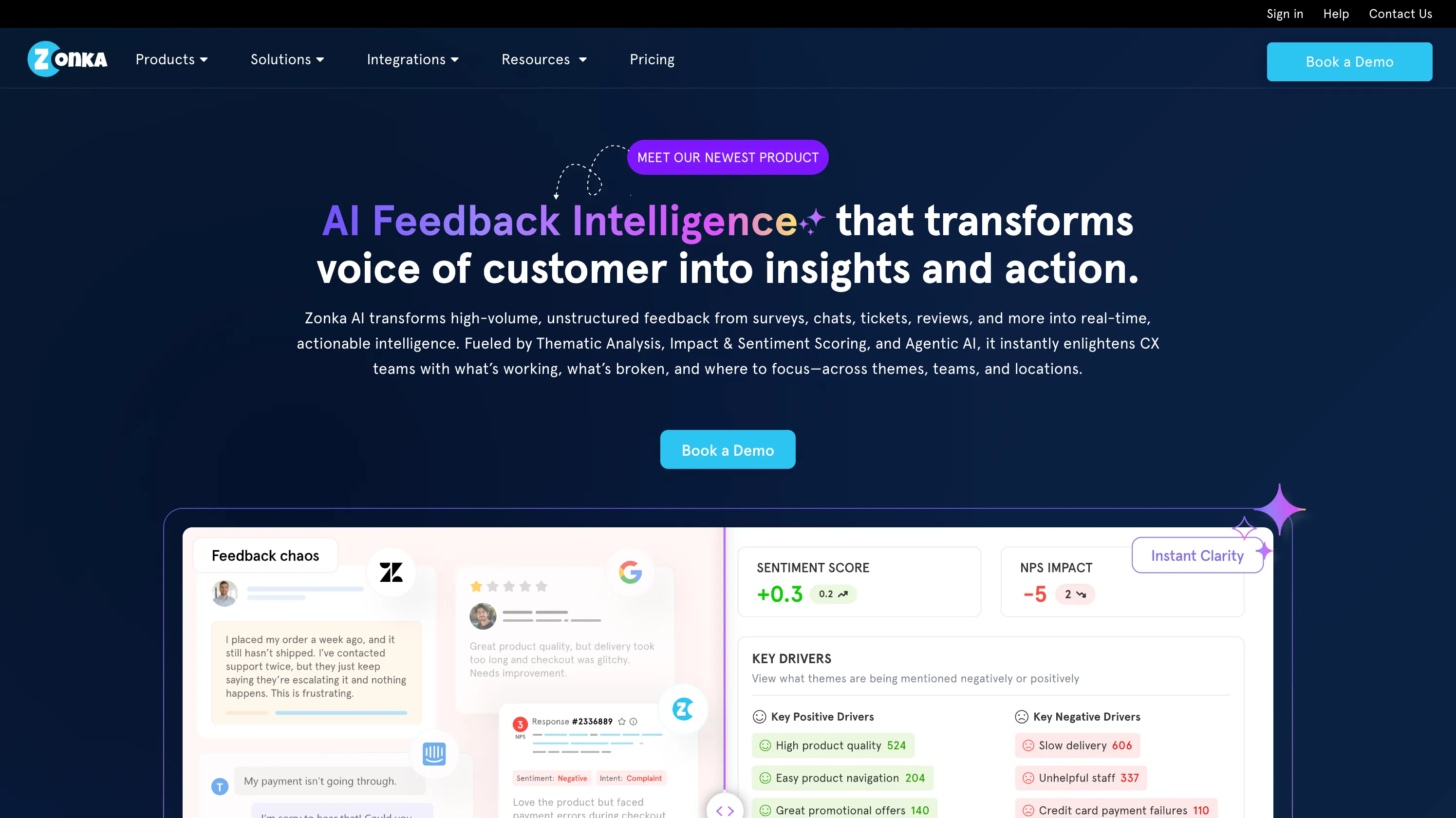
Zonka Feedback operates at a different scale than Qualaroo. In-app surveys are one channel among many: email, SMS, QR codes, WhatsApp, kiosk, and web are all part of the platform. The target buyer is an enterprise running feedback programs across multiple departments and physical locations, not a SaaS product team that needs an in-product NPS widget.
Pricing is not public. Zonka requires a demo before you can access pricing or sign up. That alone signals the intended buyer size.
What Zonka Feedback does well:
- True omnichannel coverage: Web, app, email, SMS, WhatsApp, QR code, and kiosk surveys in one platform. Qualaroo covers none of the physical or offline channels.
- AI thematic analysis: Theme detection, impact scoring, and trend identification across all feedback channels.
- Online reputation management: Built-in flows to route satisfied respondents toward review platforms.
- Deep enterprise integrations: Salesforce, HubSpot, Zendesk, and others for closing the loop between survey data and customer-facing teams.
What Zonka Feedback doesn’t do:
The complexity that makes Zonka powerful for enterprise programs is a drawback for SaaS product teams. A mandatory pre-signup demo, fully custom pricing, and a steep learning curve add friction for teams that need behavioral in-product surveys and nothing more. If your use case is purely in-product feedback for a web-based SaaS product, this is more platform than you need.
Where this fits: Multi-location businesses and large service enterprises that need unified feedback intelligence across every digital and physical customer touchpoint. If you are comparing this to Qualaroo specifically for a mid-market SaaS product, it is a significant overcorrection.
Why SaaS Survey Bills Keep Climbing
Qualaroo’s pricing model is not unusual. Most survey tools built their billing architecture around easy-to-measure metrics: pageviews, monthly active users, and email sends. These metrics existed before modern SaaS growth models did. The result is a structural misalignment that nobody designed but everybody inherited.
The specific problem with pageview-based billing is that it treats site traffic as a proxy for research value. A SaaS product having a good month (more signups, more feature adoption, more active users) gets a larger survey bill without running a single additional survey. The cost of feedback scales with product success, not research activity.
Flat pricing with response pools resolves this by billing on the unit that actually represents value: an insight collected. Whether your product has 10,000 or 100,000 monthly visitors, the cost of running five concurrent surveys does not change. For teams investing in feedback as a continuous discipline rather than a quarterly exercise, that distinction compounds over time.
How to Choose the Right Qualaroo Alternative
Start with your actual problem, not a feature checklist.
If your primary frustration is the pageview pricing or branding surcharge: Pulseahead is the direct fix. Flat $48/month with 5,000 responses and branding removal included, no pageview caps.
If you need native iOS and Android SDKs without an enterprise contract: Refiner gives you first-class mobile SDKs from the first paid plan, with advanced behavioral targeting. Iterate is the better fit if native app is your primary research surface. Blitzllama adds mobile SDKs alongside modern AI analysis on qualitative responses.
If you want multi-channel feedback beyond the in-product widget: Survicate handles in-app, email, link, and native mobile from one platform.
If you want behavioral context alongside your surveys: Hotjar connects session recordings and heatmaps to survey responses.
If you want AI-powered qualitative analysis more modern than IBM Watson: Blitzllama applies GPT-based topic clustering and theme extraction. Factor in the acquisition trajectory when evaluating long-term commitment.
If you just need simple NPS and CSAT at a clear price: Pulseahead is a strong option here too, with flat pricing and no hidden surcharges. SatisMeter is worth considering if you specifically want built-in review driver flows that prompt promoters toward G2 or Trustpilot after an NPS response.
If surveys are one of several product experience capabilities you need from a single platform: Pendo combines analytics, onboarding guides, and surveys, but at enterprise pricing and implementation overhead. Zonka Feedback is built for omnichannel CX at large enterprises with physical and digital touchpoints.
If you’re staying on Qualaroo: Qualaroo is still the best option if prototype testing on non-owned URLs is a core part of your research workflow. Running surveys on Figma prototypes, InVision links, or competitor websites is unique to Qualaroo’s platform. If that capability is critical and your traffic volume stays within the Business plan’s pageview cap, there is no compelling reason to move.
Bottom Line
The issue with Qualaroo is not the survey format. The Nudge widget works. The issue is a billing model that treats your product’s growth as a cost event, and a feature architecture that reserves mobile research for customers willing to sign an annual enterprise contract.
If your team is web-first and growing, Pulseahead replaces the core functionality at a predictable price. Core is $48/month with 5,000 responses and branding removal included. No pageview cap. No mobile SDK upsell. If you need native mobile research now, Refiner and Iterate are the cleaner paths to that capability.
Ask yourself: is your survey bill going up because you are doing more research, or because your product is getting more traffic? If it is the second one, that is the problem worth solving first.
Try Pulseahead free and run your first in-product survey in under 10 minutes.
Frequently Asked Questions
Is Qualaroo worth it for SaaS teams?
Qualaroo works well for teams with low-to-moderate traffic that need in-product surveys and prototype testing. The problems start as the product grows. Pageview-based billing means your survey cost scales with site traffic, not research activity. The separate $30/month branding surcharge and Enterprise-only mobile SDKs make the total cost harder to justify for mid-market SaaS teams that have moved past the early stages.
What features will I lose switching from Qualaroo?
The two meaningful gaps are IBM Watson sentiment analysis and prototype testing on non-owned URLs. Watson-based NLP is built into Qualaroo and most alternatives require you to handle text analysis separately or via a third-party integration. Blitzllama does include prototype testing in its template library, so that specific gap is not universal across this list. Advanced regex URL targeting for subdomain-heavy web applications is also more mature in Qualaroo than most competitors.
How long does it take to switch from Qualaroo?
For a web product, most alternatives require embedding a JavaScript snippet, passing a user ID, and configuring your first survey. Pulseahead's SaaS Survey Pack can get you from signup to a live in-product survey in under 10 minutes. Pendo and Zonka Feedback are the exceptions: both require meaningful implementation time for SDK instrumentation and event tagging before surveys are usable.
Which Qualaroo alternative has the most affordable pricing?
Pulseahead Core at $48/month covers 5,000 responses with branding removal included. SatisMeter's Growth plan is $199/month for 1,000 responses. Refiner's Essentials starts at $99/month and scales with monthly active user (MAU) count. At $48/month for 5,000 responses, Pulseahead has the lowest cost per response among the paid options listed here.
Does Qualaroo have a free plan?
Yes, but it is severely limited. The free plan covers 50 responses total across all time, not per month, plus 10,000 pageviews. In practice, it is a brief trial rather than a usable ongoing tier. Blitzllama offers the most generous free tier among these alternatives, with 500 monthly responses and 5,000 tracked users at no cost.
What is the best free Qualaroo alternative?
If you want the strongest free tier, Blitzllama is the clear leader on this list with 500 monthly responses and 5,000 tracked users. If your goal is not just "free" but "reasonable paid pricing once the trial phase ends," Pulseahead is the stronger long-term option because Core starts at $48/month for 5,000 responses instead of pushing you into steep response or pageview limits.
Who are Qualaroo's main competitors?
The main Qualaroo competitors depend on what you need. Refiner is the closest competitor for SaaS targeting depth and mobile SDK coverage. Survicate is the broader competitor if you want email, link, in-app, and mobile surveys in one place. Pulseahead is the strongest alternative if your main issue is pageview-based pricing and you want a simpler in-product system for web SaaS.
Which alternative has the best targeting for SaaS in-product surveys?
Refiner offers the deepest behavioral targeting, with event-based triggers, fine-grained user attribute conditions, and native integrations with CDPs like Segment. Pulseahead covers the SaaS-specific criteria that matter most, including days since signup, session count, user attributes, URL, and device, without the configuration overhead. Qualaroo's web targeting is comparable for web products, but Refiner and Pulseahead are more modern in execution.