

Here’s a hard truth: by the time a customer tells you they’re not renewing, it’s often too late. The real conversation happens silently in product usage patterns, support ticket flows, and unspoken frustrations. The window to save them closes fast.
You don’t need a crystal ball to see it coming though. Customers leave a trail including usage patterns, support history, and unspoken frustrations. This is where you catch renewal risks early, when intervention still works. And if you want to see how much additional revenue even a small reduction in churn could unlock, check our SaaS churn reduction calculator.
Why Customers Don’t Tell You They’re Leaving
Most churn doesn’t announce itself loudly. Between 10 and 20% of SaaS churn is involuntary (failed payments, expired cards), but the bigger problem is voluntary churn masked by silence. Customers don’t always tell you why they’re canceling. They just disappear.
A customer’s usage quietly drops. Their support tickets decrease, not because everything’s fine, but because they’ve stopped caring. Key team members leave their organization, taking your relationship with them. New stakeholders arrive, fresh and skeptical, questioning why they’re paying for something they don’t fully understand.
By renewal time, the decision is already made. It happened over weeks or months without a single conversation.
The 90-Day Window: Your Real Retention Timeline
Research from top SaaS companies shows a consistent pattern: starting renewal conversations 90 days before expiration makes a big difference. Companies that begin this early achieve 15 to 20% higher renewal rates than those waiting until the last month.
But here’s what’s critical: this window isn’t for paperwork. It’s for feedback.
The 90-day mark is where you stop guessing and start gathering intelligence. You’re running targeted surveys, analyzing product adoption metrics, and collecting sentiment before the contract expires. You’re asking customers directly: Are you getting value? What’s broken? What’s missing?
This timing matters because it gives you time to act. If you discover issues at 30 days, your options are limited. Discounts feel desperate. Promises of improvements feel hollow. But at 90 days? You can actually fix things. You can ship improvements. You can prove your commitment.
Smart teams break this window into three distinct phases: health assessment at 90 days, deeper engagement at 60 days, and final conversations at 30 days. Each phase has a purpose, and feedback collection sits at the center of each.
The Data Signals That Predict Churn
Before you even send a survey, the data is already telling stories. The trick is knowing which ones matter. Here’s how leading SaaS teams systematically identify which customers are at risk of churning before renewal time:
| Identification Method | What It Reveals | When to Apply |
|---|---|---|
| Product usage monitoring | Drops in logins, feature abandonment, or shorter sessions signal fading engagement | Ongoing, automated alerts |
| Customer health scores | A composite of usage, support, sentiment, and payment history concentrated into one number | Weekly review cadence |
| Support ticket patterns | Rising volume, repeated unresolved issues, or sudden silence can both indicate at-risk status | Ongoing and flagged in CS tools |
| Stakeholder change tracking | A departed champion or new economic buyer resets the relationship — one of the most common churn triggers | CRM-monitored |
| Renewal intent surveys | A direct question about plans to renew, expand, contract, or cancel — removes the ambiguity that health scores can’t answer | 90 days pre-renewal |
| NPS and CSAT tracking | Sentiment trends reveal accounts quietly losing confidence before they raise a formal complaint | Quarterly or event-triggered |
| Payment and billing behavior | Late payments or failed charges often signal budget pressure before any churn conversation is initiated | Automated billing alerts |
A few specifics worth knowing: usage drops above 50% are a reliable leading indicator, not a lagging one — that account is flagging itself this quarter, not next. And counterintuitively, a sudden drop in support tickets can be just as alarming as a spike. It often means the customer stopped trying to get help and is quietly walking away.
Data tells you what happened. Feedback tells you why — and that’s where your retention strategy actually works.
Asking the Right Questions: Pre-Renewal Feedback That Converts
A poorly timed survey kills two things: your response rate and your credibility. But a strategically timed, thoughtfully worded survey becomes a relationship accelerator.
The best pre-renewal feedback doesn’t just measure satisfaction. It uncovers intent and barriers. With a tool like Pulseahead, you’re not just asking customers to rate their experience on a scale of one to ten. You’re asking: “Are you planning to renew?” “What would change your mind?” “What’s preventing you from getting more value?”
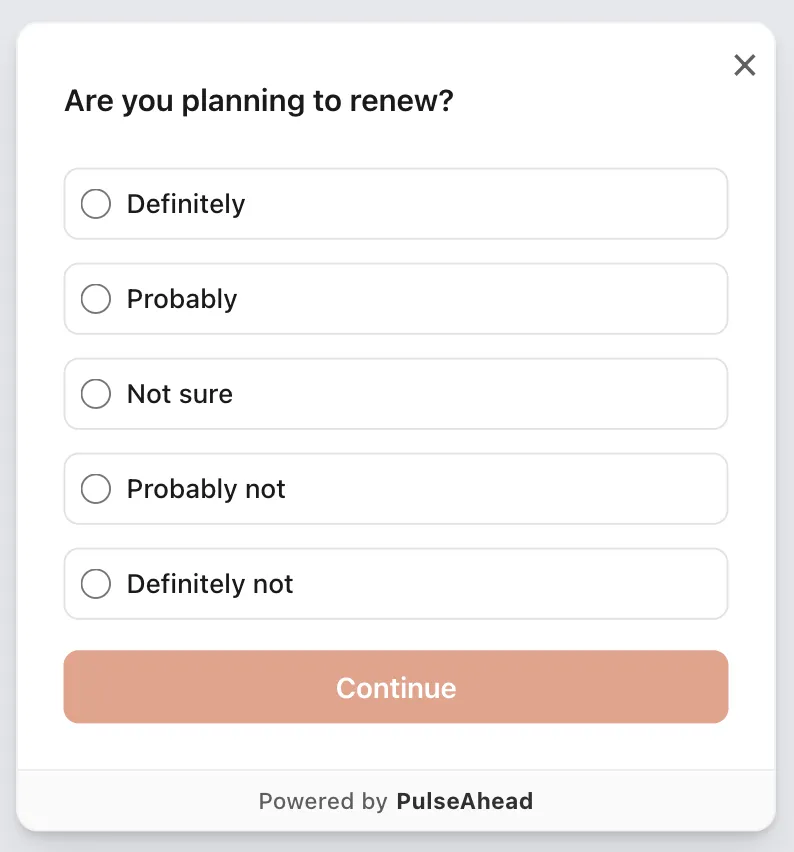
Renewal Intent Survey Example using Pulseahead
Direct intent questions work better than NPS alone. Research from customer success communities shows that asking “Will you renew, expand, contract, or cancel?” at the 140-day mark provides clearer signals than NPS alone. It cuts through the noise. A customer might love your product (high NPS), but their budget got slashed by 80% and they can’t afford to renew. That’s the real story.
The sequencing matters too. Start broad. Ask about overall satisfaction and value realization. Then go narrow. What features do they use daily? What frustrated them? What would they change? Questions should build on each other, creating a narrative rather than a checklist.
Keep it short. Seven to ten questions, maximum. Longer surveys get abandoned. The longer your survey, the fewer thoughtful answers you get. Every question should serve a purpose. If you’re not going to act on the answer, don’t ask it.
And here’s the part teams get wrong: don’t send a survey just to forecast. Your customers don’t wake up worried about your renewal accuracy. They want to know that you’re listening and that something happens because they responded. When you gather feedback, close the loop by implementing changes and telling them about it. Research shows that customers are 21% more likely to respond to your next survey when they see their input led to action.
Know who's renewing before they tell you they're not.
Building Your Risk Assessment Framework
Effective churn prediction isn’t magic, but it does require structure. Start with segmentation. Not all customers are equally valuable, and not all churn reasons are equal. A customer churning because they found a cheaper competitor needs a different playbook than one churning because they didn’t adopt the product.
Create a tiered approach based on customer value. For enterprise accounts, start renewal conversations six months out with deeper engagement and executive involvement. For mid-market, start at 90 days with standard engagement. For lower-value accounts, 60 days is often enough.
Then layer in your risk triggers. Define thresholds: What health score triggers an alert? How much usage decline equals at-risk status? What combination of factors (low usage, high support tickets, negative feedback) warrants escalation?
Most powerful organizations use a color-coded system or simple categorization. Customers fall into categories: Renew (green), Likely Renew, Neutral, At-Risk (yellow), Will Churn (red). This system gets updated regularly as new feedback comes in, and it’s visible to the entire team so nothing slips through.
Automate the alerts. When a customer crosses into at-risk territory based on your defined triggers, automated notifications go to the right team member with next-step recommendations. This removes the manual monitoring burden and ensures nobody falls through the cracks.
Turning Feedback Into Action
Finding problems is half the battle. Actually doing something about them determines whether the customer renews.
When feedback reveals issues, escalate thoughtfully. Not every problem needs a discount or win-back campaign. Some need product training. Some need deeper implementation support. Some need a price conversation.
This is where having the right tools matters. Instead of managing feedback in spreadsheets and Slack, a centralized platform like Pulseahead lets you collect and organize feedback at scale — see which pain points are showing up repeatedly across accounts, and which customer segments are struggling most.
For at-risk customers specifically, create targeted playbooks. If the issue is low adoption, offer dedicated onboarding sessions or product training. If it’s about a missing feature, show them what’s coming in the roadmap. If it’s a support issue, ensure they get white-glove assistance immediately.
The most sophisticated teams link renewal conversations to executive sponsors. For high-value at-risk accounts, involve your leadership in the renewal conversation, not just your customer success managers. It signals commitment.
Creating the Feedback Loop That Actually Works
Feedback is only valuable if it actually changes something. This is where most teams fail.
Start by listening in-product. With a tool like Pulseahead, you can deploy contextual surveys that surface while customers are actively using your app — when the experience is fresh and response rates are highest. NPS surveys layered throughout the lifecycle track loyalty trends over time. By centralizing this in-product signal, you can move from reactive support to proactive retention. If you want a pre-built set covering the full SaaS customer lifecycle — including a Churn & Cancellation survey, the SaaS survey pack has those triggers and templates ready to deploy.
Then aggregate it. Look for themes. Which issues come up repeatedly? Which customer segments mention the same problems? Which product areas generate the most negative feedback? Pattern recognition reveals priorities.
Next, act on it quickly. Speed matters. When customers see feedback translating into action within weeks, not months, they feel heard. They’re more likely to stick around and provide more feedback the next time.
Finally, close the loop by communicating back. After you implement changes, tell customers that their feedback prompted those changes. Share the improvements. Thank them explicitly for the input. This cycles your best customers into deeper engagement while showing struggling customers that you’re responsive.
The companies with the highest renewal rates treat pre-renewal feedback as a continuous system, not a one-time event. They collect it, they act on it, and they communicate the impact.
Moving Beyond Gut Feelings to Predictive Confidence
If you’ve found yourself unable to predict which accounts will churn before those renewal conversations start, it’s rarely a lack of effort. It’s a structural problem that shows up the same way across almost every CS team: usage data lives in your product analytics, support history in your help desk, sentiment scores in a separate survey tool, and commercial context in your CRM. Nothing is connected, nobody is watching it continuously, and by the time the renewal meeting is on the calendar, the signals were already there for weeks. Teams also tend to start looking too late — at 30 days out, options shrink to discounts and desperate promises. And silence gets misread as satisfaction. An account that stopped filing support tickets isn’t necessarily fine; they may have simply stopped caring enough to ask.
The solution isn’t more guessing. It’s systematic intelligence gathering through strategic feedback at the right time.
When you combine product usage data with health scores and pre-renewal feedback, you get a clear picture. You know which customers are truly at-risk months before it matters. You know specifically what’s driving the risk. You know exactly what to do about it.
This confidence changes how you operate. Instead of treating every renewal like a potential crisis, you’re managing a known pipeline. Your team spends time on customers who are genuinely struggling, not scrambling at the last minute.
For teams managing feedback at scale, in-product surveys work far better than relying on email alone. When a survey appears while customers are using your app, response rates spike and the feedback comes while problems are fresh — not weeks later when they’re forgotten.
The Playbook: Your Pre-Renewal Feedback Process
Here’s what winning teams actually do:
120 days before renewal: Gather baseline data. Review usage metrics, analyze support history, and score customer health. Identify at-risk accounts and normal accounts based on predetermined thresholds.
90 days before renewal: Launch your first feedback round. Send a targeted survey asking about value realization, satisfaction, and renewal intent. Include a direct question: “Do you plan to renew, expand, contract, or cancel?” Segment responses and flag anything red or yellow for immediate follow-up.
60 days before renewal: Deepen engagement with at-risk customers. Schedule check-ins with struggling accounts. Share success metrics showing the value they’ve received. Address specific pain points mentioned in feedback. For healthy accounts, send a quick appreciation message and confirm renewal timing.
30 days before renewal: Finalize terms and prepare contracts. For at-risk accounts still in the balance, involve executive sponsors. Make final value arguments backed by feedback from their own team. For healthy accounts, confirm renewal and discuss any expansion opportunities.
Post-renewal: Close the loop. Tell customers about improvements made based on their feedback. Thank them for responding to surveys. Set the stage for the next cycle.
Why This Works (And Why It Prevents Disasters)
The companies with 90% plus renewal rates aren’t luckier. They’re more intentional.
Customers don’t churn by surprise if you’re paying attention. They give you signals. Product usage tells you part of the story. Support tickets tell you another part. But direct feedback from the customer themselves, asked at the right time with the right questions, is where renewal certainty comes from.
The window between today and renewal is your runway to fix things, strengthen relationships, and secure growth. Use pre-renewal feedback to fly that runway with intention, not hope. The teams doing this best are implementing continuous feedback loops, not one-off surveys, treating feedback collection as a core retention competency that runs through their entire customer journey.
Skip the guesswork. Start with ready-made Pulseahead templates.