

If you’re looking for Delighted alternatives because the product is shutting down, the deadline is real. Qualtrics acquired Delighted and is sunsetting it on June 30, 2026. No new signups since July 2025. Just a hard deadline and a migration you can no longer defer.
Structurally, Delighted had limits well before the announcement. Response volumes were thin relative to price: 100 responses per month at $39, 500 at $249. It had multi-channel delivery (email, web, SDK, embed), but behavioral triggering stayed shallow: user properties and time-based cadences, not the event-driven targeting SaaS product teams now rely on. Survey types covered NPS, CSAT, CES, and 5-star ratings, but there were no purpose-built templates for the SaaS user lifecycle: onboarding, activation, churn, or feature adoption. And with feature development stalled after the Qualtrics acquisition, those gaps were never going to close. Check out the Delighted pricing breakdown for more details.
Here are 9 Delighted alternatives and competitors evaluated for SaaS product teams, compared on in-product delivery, behavioral triggering depth, response volume economics, and fit for product-led teams versus broader CX programs.
Quick Comparison
| Tool | Best For | Starting Price | In-Product Delivery | Free Plan |
|---|---|---|---|---|
| Pulseahead | In-product lifecycle surveys for SaaS | $48/mo (5,000 responses) | Yes | Yes |
| SatisMeter | Simple always-on NPS/CSAT for web SaaS | $199/mo (1,000 responses) | Yes (web only) | No |
| Refiner | High-response microsurveys with precise segmentation | $99/mo (5k MAU) | Yes (web + native mobile) | No |
| Survicate | Multi-channel VoC across web, email, and in-app | $89/mo (100 responses) | Yes | Yes |
| Simplesat | Ticket-level CSAT for support-driven teams | $119/mo (1,000 responses) | Yes | No |
| Qualaroo | UX research and conversion optimization on websites | $39.99/mo | Web + mobile (Enterprise only) | Yes |
| Iterate | Native mobile app surveys, event-triggered | From $25/mo | Yes (mobile-first) | No |
| Hotjar | Behavior analytics plus on-site surveys | $99/mo (500 responses) | Web/on-site | Yes |
| Wootric (InMoment) | Enterprise NPS monitoring, legacy scale | Contact sales | Yes | No |
1. Pulseahead: Best for in-product SaaS feedback without the pricing shock
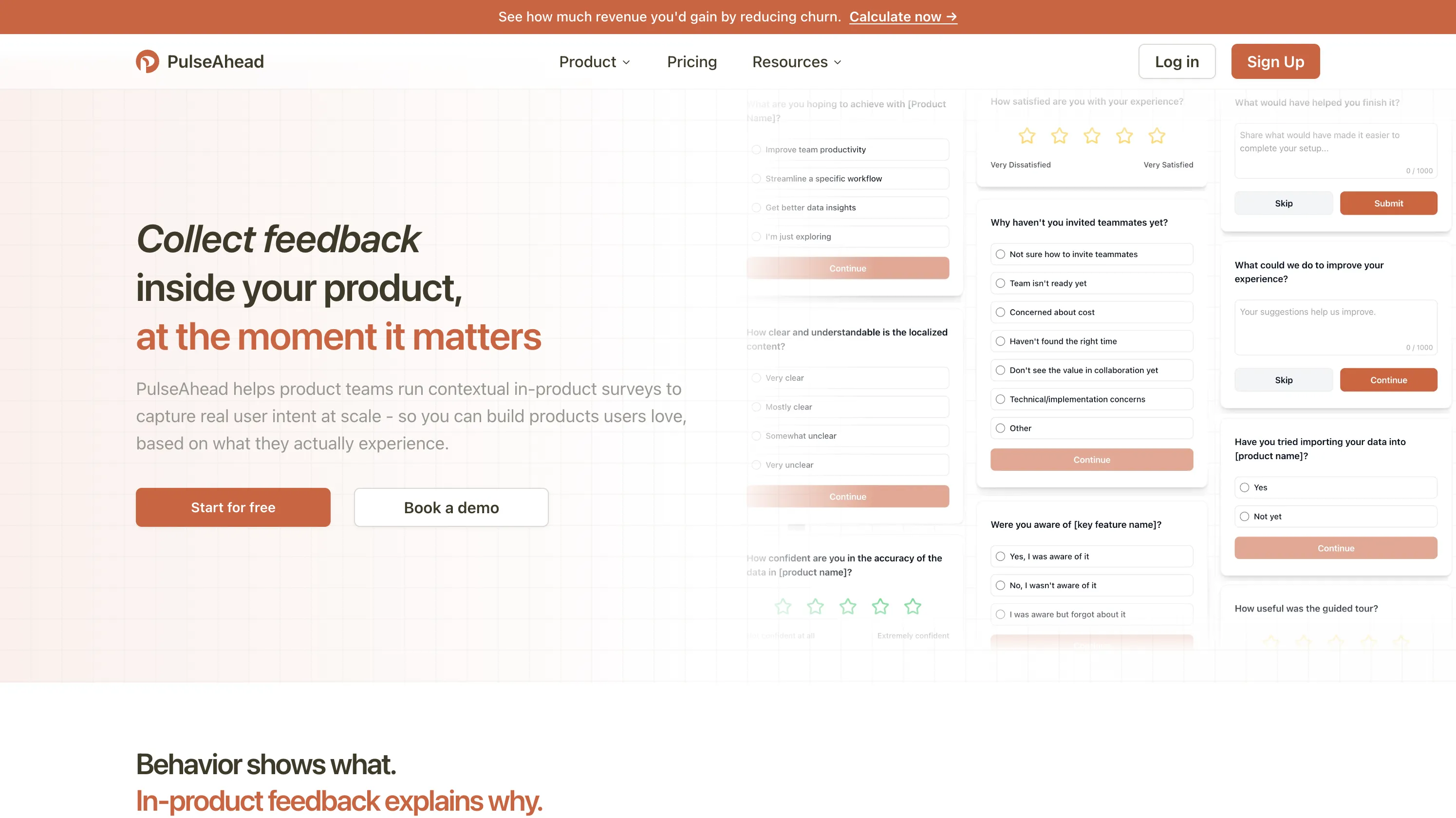
You’re leaving Delighted because the platform is shutting down. When you move, you have a choice: find another tool that runs the same NPS program on different infrastructure, or use the moment to fix what was always missing. Pulseahead is built for the second option. Our flat rate pricing keeps survey costs predictable as you scale.
Pulseahead delivers in-product surveys with timing controls SaaS teams can actually use: session count, days since signup, URL targeting, and custom user attributes. Delighted had web and SDK delivery, but its targeting logic stayed closer to user properties and time intervals. Pulseahead’s bigger advantage is not a deep event engine, it is the SaaS Survey Pack: six lifecycle surveys you can launch together, tune quickly, and review through a pre-built dashboard instead of rebuilding the whole program from scratch.
What Pulseahead does well:
- Contextual in-product targeting: Trigger surveys by session count, days since signup, URL rules, or custom user attributes. If your app needs exact control, Pulseahead also supports manual SDK trigger. That gives SaaS teams more practical timing options than Delighted’s property-plus-cadence model.
- SaaS Survey Pack: the SaaS Survey Pack includes six pre-configured lifecycle surveys for onboarding, activation, product-market fit, NPS, churn, and user profile feedback. Delighted covered NPS, CSAT, CES, and 5-star ratings, but it did not give SaaS teams a ready-made survey system for the core lifecycle moments from signup through retention.
- Response economics: Core starts at $48/month for 5,000 responses. Delighted’s Premium was $249/month for 500. That difference compounds as your program scales.
- User segmentation: Identify users via the SDK, then target by plan tier, company size, custom traits, or prior behavior, without engineering tickets.
- Active development: Pulseahead ships features weekly, specifically for SaaS use cases. Delighted entered maintenance mode after the Qualtrics acquisition.
What Pulseahead doesn’t do:
No email or SMS delivery. If a portion of your Delighted program reached users via email who weren’t actively using your product, you’ll need a separate channel for that cohort. No native iOS or Android SDKs; delivery is web and mobile web.
Pricing:
Core is $48/month for 5,000 responses. Pro is $108/month for 10,000. No per-response metering, no overage charges. Your survey bill doesn’t change when you have a good growth month.
Try Pulseahead free and run your first in-product survey in under 10 minutes.
2. SatisMeter: Best for simple, always-on NPS in web SaaS
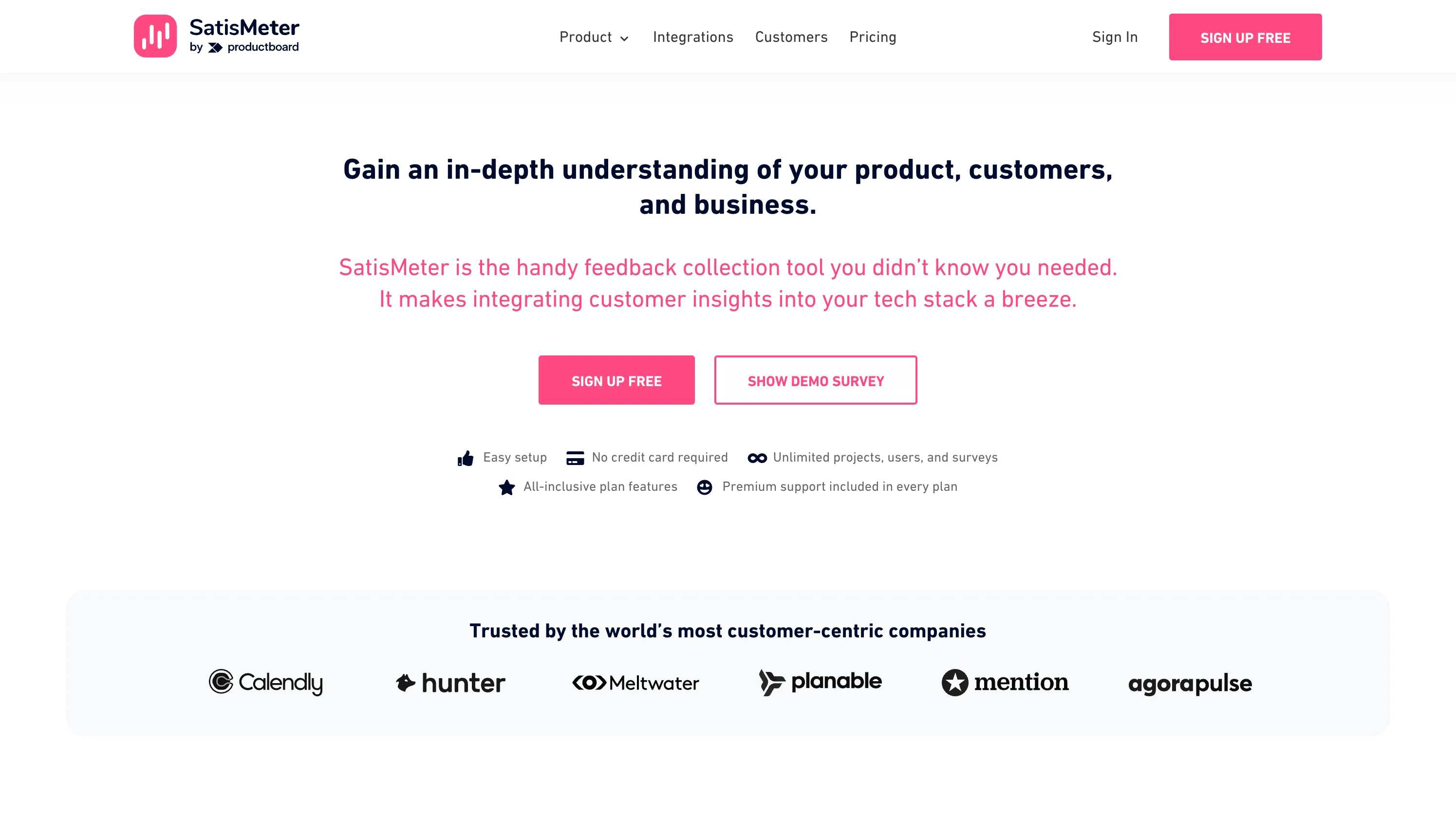
SatisMeter is the most direct replacement for what Delighted did in its best years: clean, lightweight NPS and CSAT with minimal configuration. It installs via Segment or Google Tag Manager, delivers surveys inside your web app, and includes all features in every plan rather than gating capabilities behind higher tiers. The Growth plan is $199/month for 1,000 responses, more than double Delighted’s Premium allowance at a lower price. For a SaaS team that just needs NPS running again without rebuilding their entire feedback stack, SatisMeter is the path of least resistance.
What SatisMeter does well:
- Quick web app integration: Segment or GTM installation means no custom code. Time from signup to live survey is measured in hours, not days.
- All-inclusive plans: full functionality at every tier; the only variable is response volume.
- Review amplification: routes promoters to G2, Capterra, or Trustpilot directly after a positive score.
- Clean, high-converting UX: survey design prioritizes response rates, in the same tradition that made Delighted popular.
What SatisMeter doesn’t do:
No native iOS or Android SDK. Reporting is light for teams who want qualitative text analysis beyond keyword detection. Behavioral triggering is functional but not as deep as Refiner or Pulseahead.
Worth choosing if you run a web SaaS product and need NPS back up quickly without complex targeting logic. If you need full mobile coverage or survey types beyond NPS and CSAT, the next options go further.
3. Refiner: Best for high-response microsurveys with precise targeting
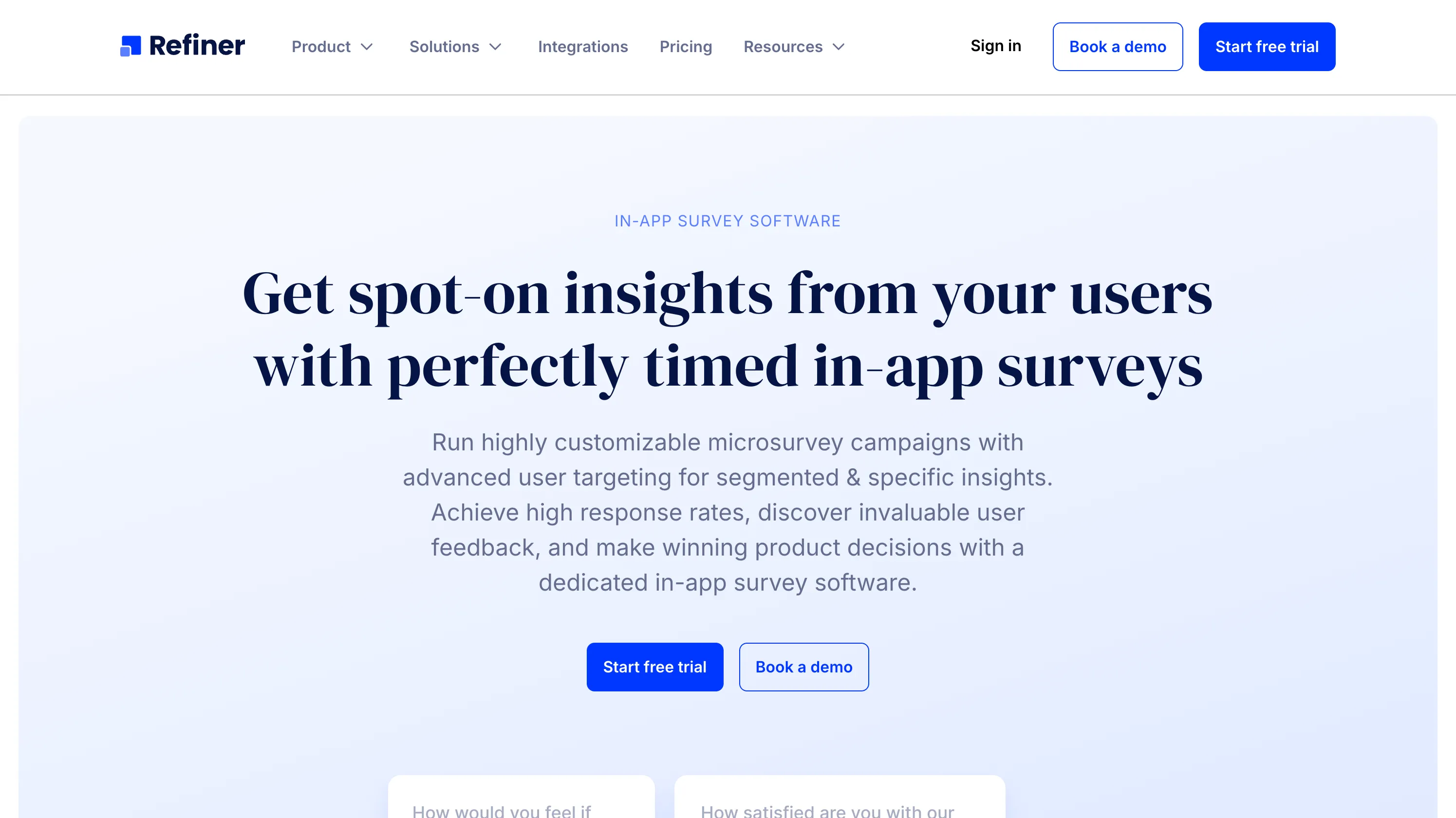
Refiner lets you target surveys by user traits, behavior, device, language, and even responses to prior surveys. The setup is more involved, but so is the precision. Refiner has published case studies with in-app response rates above 57%, driven primarily by delivery timing and targeting depth. The Essentials plan starts at $99/month for 5k MAU with unlimited responses; the Growth plan at $239/month adds Segment, Amplitude, HubSpot, and Salesforce integrations.
What Refiner does well:
- Advanced segmentation: target by plan tier, lifecycle stage, device, language, or answers from previous surveys. Delighted offered property-based user targeting; Refiner’s targeting engine is event-driven and substantially more granular.
- Full mobile coverage: native SDKs for iOS, Android, React Native, and Flutter.
- Integration depth: pre-built connections to Segment, Amplitude, Mixpanel, Customer.io, HubSpot, and Salesforce.
- Multi-channel delivery: in-app web, mobile SDK, email, and link surveys in one platform.
- AI response tagging: automatic categorization of open text themes reduces manual review time.
What Refiner doesn’t do:
Delighted offered relatively quick setup with property-based targeting; Refiner requires more configuration to unlock its event-driven depth. For very high-volume consumer apps, refiner’s pricing can climb.
Best for mid-market SaaS teams and mobile-first product teams who need precise targeting and are prepared to invest time in initial setup.
4. Survicate: Best for centralizing feedback across every touchpoint
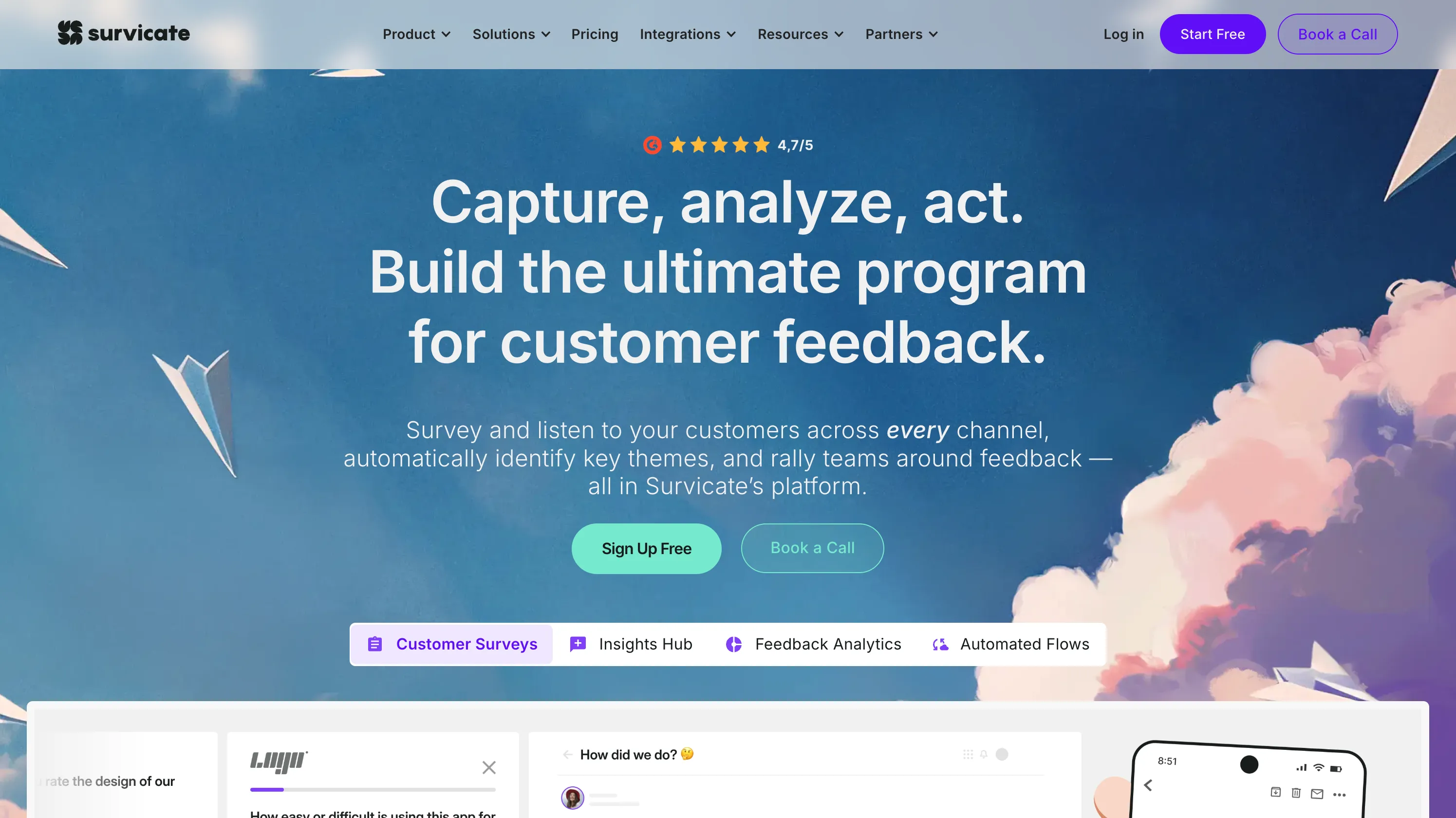
Survicate extends what Delighted did into territory it never covered. Both tools offer multi-channel delivery (web, email, SDK), but Survicate adds an AI layer that aggregates and categorizes feedback from outside your survey program: support tickets, Google reviews, app store ratings, G2 mentions. If the problem is fragmented feedback spread across sources rather than a single delivery channel, that aggregation layer is the real differentiator. The Starter plan is $89/month for 100 responses (or $179/month for 250); higher tiers require annual commitment. See our Survicate pricing breakdown for how the Starter and annual plans compare.
What Survicate does well:
- Multi-channel coverage: website pop-ups, in-app surveys, email campaigns, mobile apps, and Intercom and Braze chat widgets.
- AI Insights Hub: automatically categorizes feedback across surveys, support tickets, and review platforms using natural language processing.
- 50+ integrations: HubSpot, Salesforce, Freshdesk, Zendesk, Slack, Mailchimp, and more.
- Recurring and behavioral triggers: automated distribution tied to lifecycle stages or events.
What Survicate doesn’t do:
Event-based targeting and advanced segmentation are locked behind the Pro plan ($349/month, annual commitment). Teams who only need behavioral in-product surveys may pay for capabilities they never use.
Best for mid-market to enterprise teams who want a single platform that unifies feedback across every channel.
5. Simplesat: Best for support-driven SaaS teams measuring CSAT after every ticket
Simplesat solves a specific problem: capturing CSAT on every support interaction, automatically, tied to the ticket that generated it. SaaS companies with high-volume support operations, where the quality of each resolved ticket is a real business metric, get a purpose-built workflow that generic survey tools don’t provide natively. It integrates with Zendesk, Freshdesk, HubSpot, ConnectWise, and Autotask, pulling CSAT feedback automatically after each ticket closes. Standard plan starts at $119/month for 1,000 monthly responses.
What Simplesat does well:
- In-email-signature surveys: a survey embedded in the closing message of every support reply captures feedback while the interaction is fresh.
- Agent leaderboards: built-in performance tracking tied to CSAT scores, useful for support team accountability and internal reporting.
- Helpdesk integration depth: automated end-to-end CSAT collection via Zendesk, Freshdesk, HubSpot, ConnectWise, and Autotask.
- Review amplification: routes promoters to G2, Trustpilot, and other review platforms after positive scores.
What Simplesat doesn’t do:
No behavioral triggering tied to product usage events. Delivery is tied to support workflows: email signatures, ticket follow-ups, and helpdesk integrations. It won’t cover SaaS lifecycle moments like onboarding completion, feature adoption, or churn signals; those require triggering logic based on what users do inside your product, not on resolved tickets.
Worth choosing if your SaaS has a meaningful support operation and you want per-ticket CSAT automated across your helpdesk. If your need is product-led feedback tied to feature usage and user behavior, the other tools on this list fit better.
6. Qualaroo: Best for UX research and conversion optimization on websites
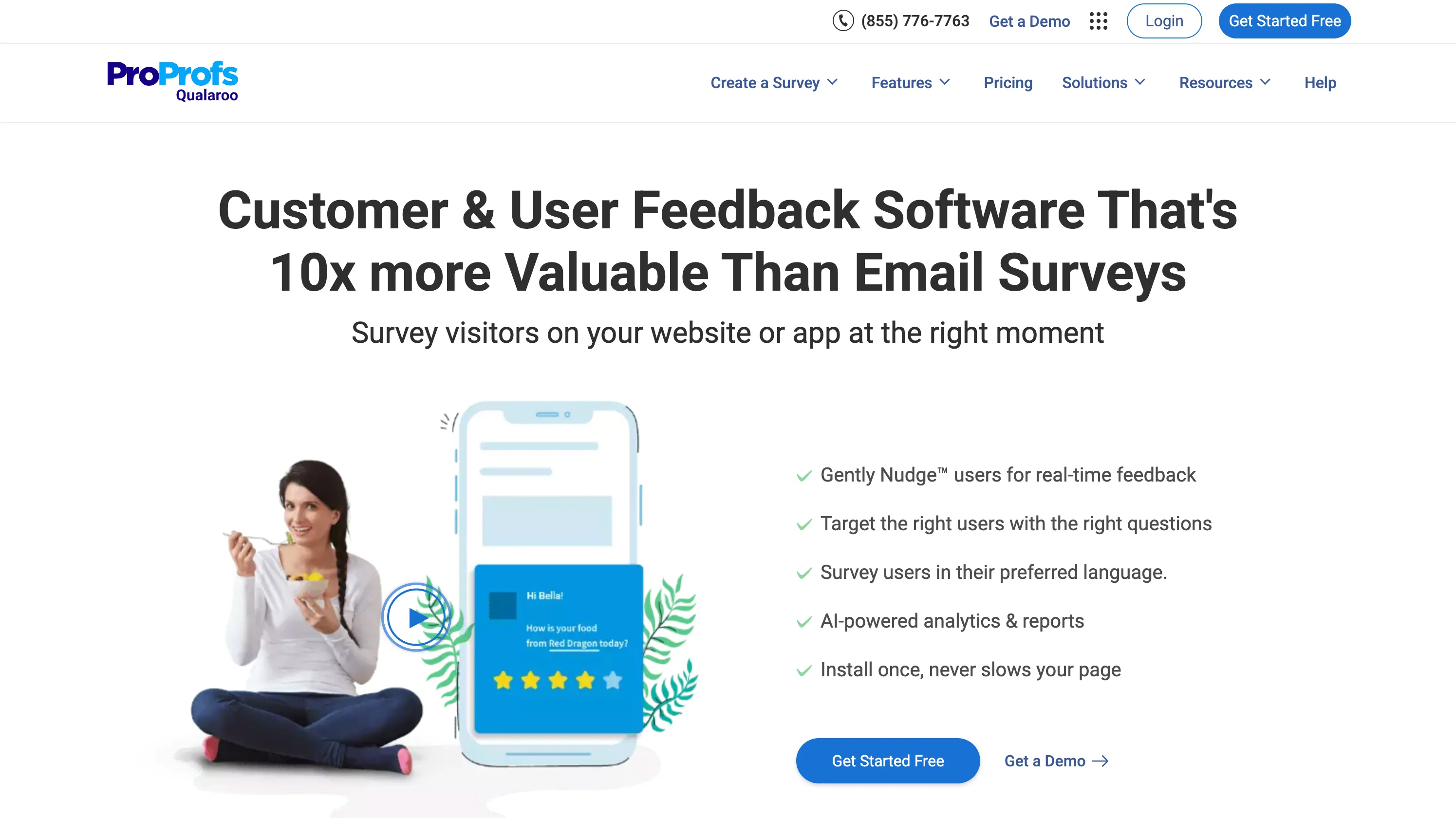
Qualaroo pioneered a small, unobtrusive survey widget, the Nudge, that appears on a specific page, at a specific scroll depth, or on exit intent. The primary use case is website UX and conversion rate optimization. If the question is “why aren’t users converting on our pricing page,” Qualaroo is built to answer it. Business plan is $69.99/month with unlimited responses and 100k monthly pageviews; the forever-free plan covers 50 responses per month.
What Qualaroo does well:
- Granular web targeting: scroll depth, time-on-page, and exit intent triggers let you ask users exactly why they’re leaving a specific page.
- IBM Watson sentiment analysis: natural language analysis with sentiment classification, more sophisticated than Delighted’s basic keyword detection.
- Forever-free plan: accessible for small teams who need basic on-site feedback without a paid commitment.
- Conversion-focused question types: short, high-completion surveys designed for specific pages in the conversion flow.
What Qualaroo doesn’t do:
Native iOS and Android SDK exists but is gated behind the Enterprise plan ($149.99/month, annual only). The dashboard feels dated compared to tools built in the last few years. Not designed for always-on NPS programs across the full SaaS lifecycle.
Best for e-commerce and marketing-heavy SaaS teams who want to understand drop-off on specific pages. Less relevant for product teams running lifecycle surveys across the user journey.
7. Iterate: Best for mobile-first teams running event-triggered surveys
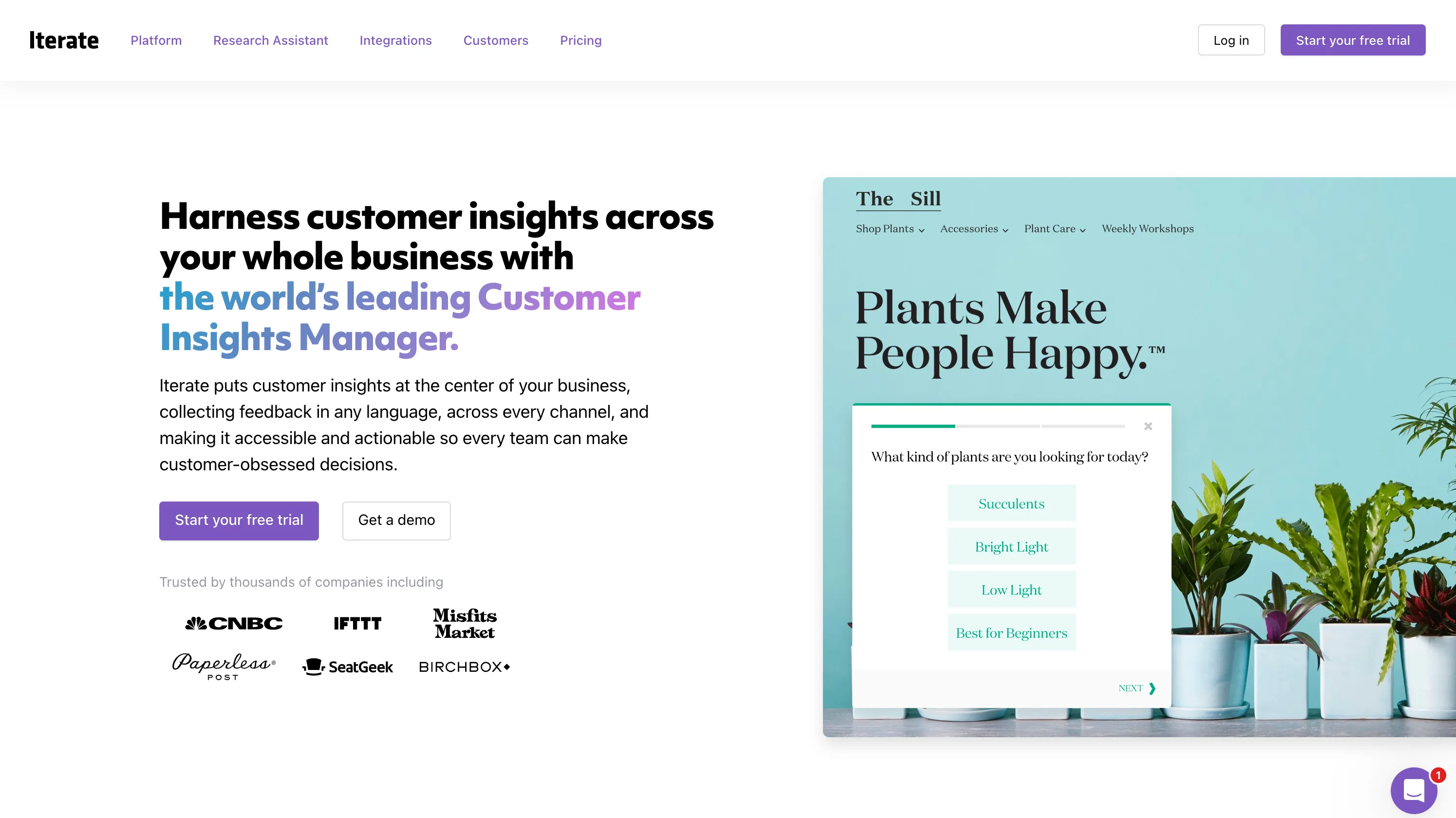
Iterate is built for mobile app teams first and web teams second. The iOS, Android, and React Native SDKs are the primary surface. Delighted had a web SDK, but it wasn’t built around the native mobile experience: tap targets, native animations, response flows that feel like part of the app rather than a web widget dropped in. For teams whose users are primarily in a native mobile app and who need surveys that feel genuinely native to that environment, Iterate is the more purpose-built option. Pricing starts from $25/month for 10k MAU with unlimited responses; white label, research assistant, and premium integrations (Braze, Iterable, Segment) are priced as add-ons.
What Iterate does well:
- Native mobile UX: survey design optimized for tap targets, animation, and response flow that feels native to iOS and Android rather than ported from a web widget.
- Event-driven triggering: surveys fire on specific user actions or app events, not just time intervals. Show a survey after a user completes an onboarding workflow, not three days after signup.
- Design flexibility: more branding control than Delighted’s email template.
- Sampling controls: holdback and sampling percentages to control what fraction of eligible users see each survey.
What Iterate doesn’t do:
Analytics are lightweight for teams who need deep trend reporting or text analysis across thousands of responses. The integrations ecosystem is smaller than Refiner or Survicate.
Best for consumer mobile apps and SaaS companies with significant native mobile usage. If web is your primary surface, Refiner or SatisMeter cover that space more completely.
8. Hotjar: Best for combining behavior data and on-site surveys
Hotjar is an analytics platform that happens to include surveys. Heatmaps, session recordings, and funnel analysis are the core product; surveys sit alongside them as a complementary feature. Growth plan starts at $99/month for 500 survey responses, scaling to $329/month for 5,000. For teams who’ve always wanted behavioral context next to their feedback, the appeal is concrete: you can watch the session recording of the exact user who gave you a detractor score and trace back what happened.
What Hotjar does well:
- Session recording paired with surveys: when a user submits a negative score, trace through their session to see what triggered it. This closes a context gap that survey-only tools leave open.
- Heatmaps and funnel analysis: core features, not higher-tier add-ons.
- Freemium entry: free tier includes 3 feedback widgets and 100 survey responses per month.
- High-traffic website coverage: behavioral analytics and on-site survey collection in one platform.
What Hotjar doesn’t do:
Survey logic, branching, and distribution channels are limited compared to tools built specifically for surveys. No email survey delivery. Pricing scales with site traffic, not survey volume. For a SaaS product team that primarily needs in-product NPS and lifecycle surveys, you’re paying for a full analytics suite to access a survey widget.
If behavioral analytics alongside surveys is the goal, Hotjar makes genuine sense. If lifecycle surveys with behavioral triggering are the goal without the visual analytics, the survey-focused tools on this list give you more depth per dollar.
9. Wootric (InMoment): Best for enterprise teams prioritizing sentiment analysis at scale
Wootric replicates Delighted’s core NPS/CSAT functionality and adds machine learning-powered sentiment analysis. Teams evaluating it as a replacement should know upfront: Wootric went through the same acquisition trajectory that’s closing Delighted’s doors. InMoment acquired Wootric in 2021 and has since been integrating it into the broader InMoment XI enterprise platform. Standalone feature development has slowed. Teams leaving Delighted because an acquisition stalled product development may find themselves in the same position again. Pricing is contact sales only.
What Wootric does well:
- Machine learning sentiment classification: auto-categorizes open text feedback themes at scale, more sophisticated than most NPS-focused tools offer.
- Always-on CX governance: designed for enterprise-scale continuous NPS programs with organizational controls.
- Established data integrations: connects to major data warehouses and CRM platforms for organizations with sophisticated data stacks.
- Familiar program structure: reporting framework immediately recognizable to teams that have run NPS programs for years.
What Wootric doesn’t do:
Like Delighted, Wootric is primarily NPS, CSAT, and CES focused. Specialized SaaS survey types require workarounds. The commercial path pushes toward InMoment’s full enterprise suite, which carries enterprise pricing.
Best for mid-market and enterprise legacy brands comfortable with contact-sales pricing. Swapping one acquired, stagnating product for another is a lateral move at best.
See also: Best Wootric alternatives.
What the Delighted shutdown means for your migration
Most tools wind down slowly. Delighted has a hard date. The underlying dynamic is familiar: a capable product gets acquired, enters a roadmap that serves the acquirer’s enterprise strategy, and the original customer base waits years for improvements that never arrive.
What Delighted did well it did simply: multi-channel delivery, clean survey UX, standard CX metrics (NPS, CSAT, CES, 5-star) that were easy to set up. What it never solved was contextual in-product timing for modern SaaS teams. Property-based targeting and time cadences work for a periodic NPS pulse; they do less well when you want structured lifecycle surveys running inside the product, tied to signup age, session count, URLs, user attributes, or app-controlled trigger points. Teams that use this Delighted sunset to add that context will collect insights their old program never reached.
How to choose the right Delighted alternative
If you just need NPS running again with minimal disruption:
- SatisMeter: fastest path back to clean, always-on NPS for a web SaaS app. All features included in every plan, $199/month for 1,000 responses.
- Pulseahead: if you want to land in a better position than where Delighted left you, with in-product delivery, contextual targeting, and a ready-made SaaS survey system from day one.
If you want to move from property-based targeting to more contextual in-product timing:
- Pulseahead: session count, URL rules, user attributes, and a SaaS Survey Pack that gets six lifecycle surveys live quickly without configuring each one from scratch.
- Refiner: deeper event-based targeting and native mobile SDKs if your audience spans web and native mobile.
If you run a native mobile app and need surveys inside that experience:
- Refiner: iOS, Android, React Native, and Flutter SDKs with full behavioral targeting and multi-channel delivery.
- Iterate: specifically optimized for mobile-first survey UX and event-driven delivery within native app environments.
If you want to centralize feedback from surveys, support tickets, and reviews:
- Survicate: AI-powered Insights Hub that categorizes feedback across every source. Useful when the problem is fragmented feedback rather than just a missing delivery channel.
If your SaaS has a high-volume support operation and you want per-ticket CSAT automated:
- Simplesat: integrates with Zendesk, Freshdesk, HubSpot, ConnectWise, and Autotask to automate CSAT collection after every resolved ticket.
If your primary goal is understanding conversion and UX drop-off on website pages:
- Qualaroo: scroll depth, exit intent, and time-on-page targeting designed for website conversion optimization. Free plan available.
If you need session recordings and heatmaps alongside on-site surveys:
- Hotjar: behavior analytics with surveys included. The right choice when visual behavior data is the primary need; less efficient when surveys are the only need.
If you’re staying on Delighted until June 30, 2026:
- A reasonable choice if you have a running NPS program and have already started evaluating alternatives. Export your response data before the deadline.
Bottom Line
A platform sunsetting with a hard date forces a decision most teams would otherwise defer. What’s worth recognizing is that the tools listed here aren’t equivalent: they differ on a dimension that matters more than pricing or integrations. Email-after-the-fact versus in-product at the moment of use is a fundamental difference in what feedback you’re able to collect, not just how you collect it.
Pulseahead is built for SaaS product teams who want feedback collected inside the product, with timing rules and survey coverage that fit how SaaS users actually adopt a product. Flat pricing at $48/month for 5,000 responses means the bill doesn’t grow when your product has a good month. Unlike the platform you’re leaving, Pulseahead gives you a faster path to a full survey system: product-market fit tracking, onboarding surveys, activation feedback, churn signals, and a dashboard designed around those metrics.
The teams that get the most from this migration aren’t the ones who find the fastest path back to where they were. They’re the ones who solve the timing problem Delighted never did.
Try Pulseahead free and run your first in-product survey in under 10 minutes.
Frequently Asked Questions
Is Delighted actually shutting down?
Yes. Qualtrics officially announced the sunset of Delighted, closing June 30, 2026. New signups were stopped in July 2025. Existing users can continue until the shutdown date, but planning a migration now is essential.
Why is Delighted shutting down after the Qualtrics acquisition?
Delighted is being retired as Qualtrics consolidates customers into its broader platform. That usually means the parent company prioritizes enterprise standardization over keeping a smaller standalone product moving. For SaaS teams, the practical takeaway is simple: treat Delighted as end of life and pick the replacement that fits your actual survey workflow.
What happens to Delighted integrations when I switch?
Delighted built deep integrations with Salesforce, Slack, HubSpot, and Zendesk over more than a decade. Most alternatives cover the major platforms, but connector depth varies. Refiner and Survicate have the broadest integration ecosystems among the tools compared here. Verify any critical integration before committing.
How long does switching from Delighted actually take?
The technical switch, installing a new snippet or SDK, porting survey templates, typically takes a day. The more meaningful work is configuring in-product timing rules and lifecycle coverage that go beyond Delighted's property and time-cadence model. Budget a week or two to validate that surveys fire at the right moments for the right user cohorts.
Does Delighted have a free plan worth using before migration?
Delighted offers a free tier limited to 25 responses per month. That's enough to understand the interface but not enough for a real survey program. Given the platform is closing, evaluating alternatives is a better use of time.
Which Delighted alternative is best for NPS surveys?
If you want the closest replacement for a simple, always-on NPS or CSAT program, start with SatisMeter. If you want NPS inside a broader SaaS feedback system with onboarding, activation, PMF, and churn surveys, Pulseahead is the stronger option because the program can expand without changing tools again.
Looking for more context on how survey tools differ for SaaS teams? Read our guide to types of survey tools for SaaS.