

Survicate is easy to like on the first pass. It covers web, in-product, mobile, email, links, and AI-assisted analysis from one dashboard.
Survicate’s monthly Starter plan starts at $89/month for 100 survey responses a month. If your real need is recurring in-product lifecycle feedback, not a broad omnichannel feedback hub, there are cleaner options.
Here are 9 alternatives that solve that problem in different ways, compared on pricing shape, in-product targeting, channel breadth, and fit for recurring SaaS lifecycle surveys.
Quick Comparison
| Tool | Best For | Starting Price | Pricing Shape | Free Plan |
|---|---|---|---|---|
| Pulseahead | SaaS lifecycle surveys with flat pricing | $48/month | Flat monthly plans with response pools | Yes |
| Qualaroo | Lower-cost website nudges and microsurveys | $19.99/month | Unlimited responses, pageview and email limits | Yes |
| Refiner | Deep SaaS segmentation with mobile coverage | $99/month | MAU-based | Yes |
| Typeform | Polished link-based surveys and forms | $39/month | Response tiers by plan | Yes |
| Hotjar | Feedback plus session replay and heatmaps | Custom/varies | Voice of Customer inside a broader suite | Yes |
| Pendo | Product analytics, guides, and surveys together | Custom pricing | MAU-based enterprise suite | Yes |
| Iterate | Mobile-first survey programs with white-label options | $25/month | Usage-based with add-ons | 14-day trial |
| SurveyMonkey | Broad research and internal stakeholder familiarity | $30/user/month | Per-user plans plus response limits | Yes |
| Zonka Feedback | Omnichannel CX programs with enterprise controls | Custom quote | Quote-based, response-tiered | 14-day trial |
1. Pulseahead: Best for focused SaaS lifecycle feedback without response anxiety
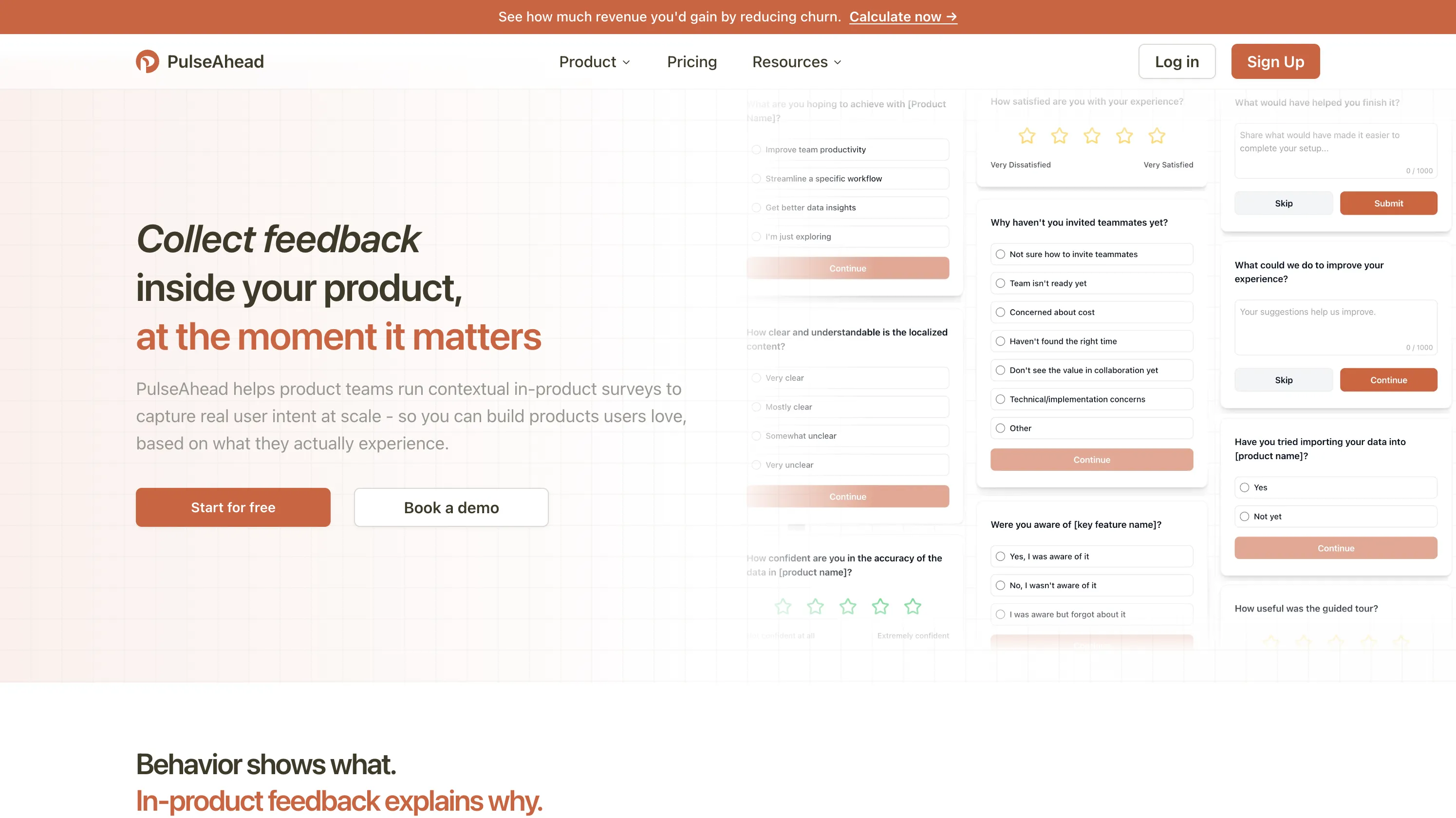
Teams usually leave Survicate because pricing starts shaping survey behavior, or the product feels broader than the job they need done. Pulseahead is the narrower answer on purpose.
What Pulseahead does well:
- Flat pricing - Core is $48/month for 5,000 responses and Pro is $108/month for 10,000 responses. No annual gate, overage math, or MAU tax.
- SaaS timing controls - Target by days since signup, session count, URL, browser, OS, country, platform, and user attributes. Use a manual SDK trigger when the app needs exact control.
- Survey fatigue controls - One-time or recurring display, global cooldown, and per-survey repeat delay matter once you run more than one survey at a time.
- SaaS Survey Pack - Six lifecycle surveys can launch together with shared setup and a pre-built dashboard, which is faster than assembling a program survey by survey.
What Pulseahead doesn’t do:
Pulseahead is web and mobile web only. No native iOS or Android SDKs. It also does not try to be an email, reviews, and omnichannel feedback hub, which means Survicate still covers more ground if channel breadth is the priority.
Choose Pulseahead if you want recurring in-product SaaS feedback with predictable pricing and a faster path from setup to usable signal.
Try Pulseahead free and launch your first in-product lifecycle survey in under 10 minutes.
2. Qualaroo: Best for cheaper website nudges if your program stays simple
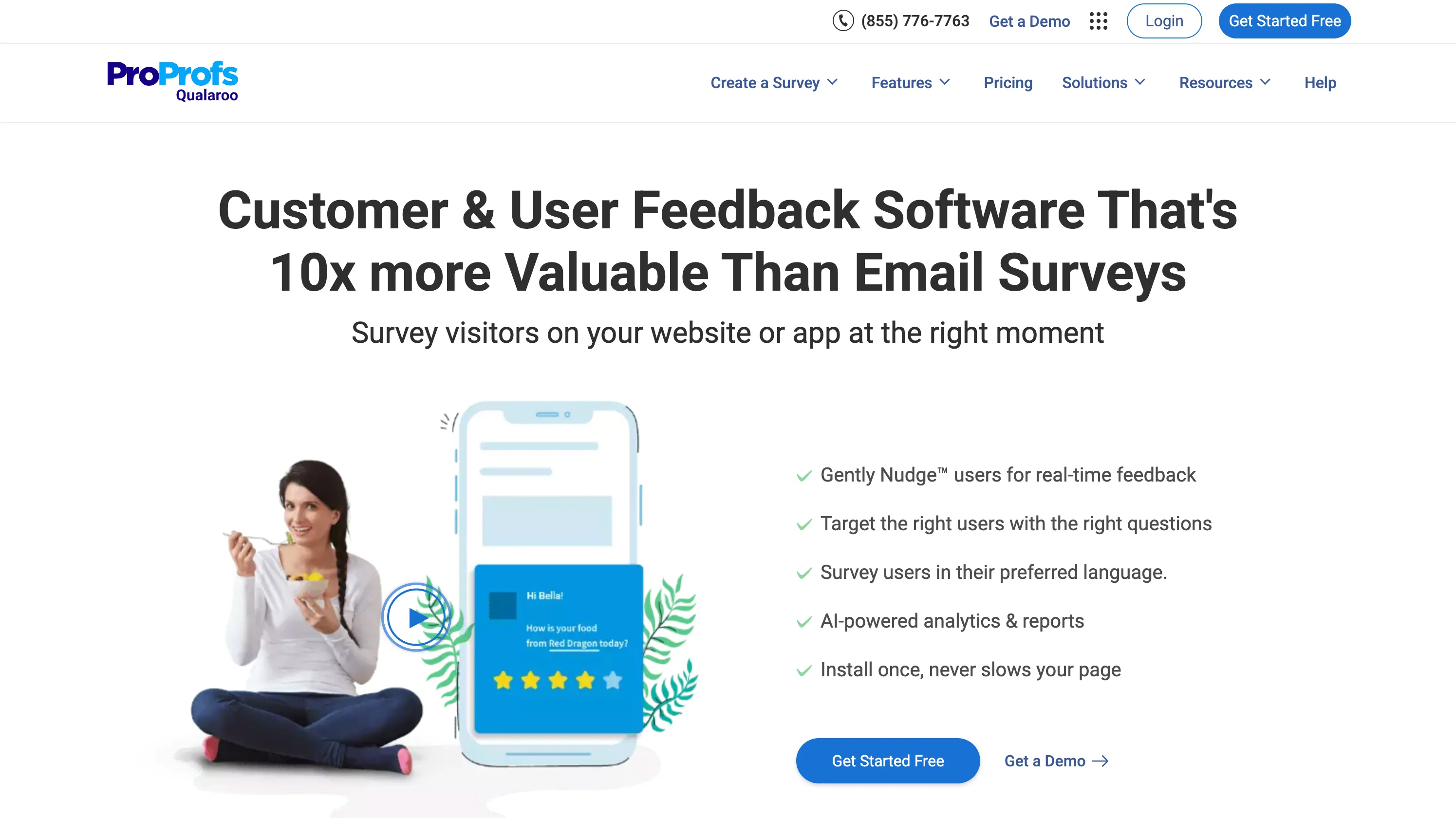
Qualaroo is closer to Survicate than it first appears: website nudges, short microsurveys, and targeting without buying a broader suite.
Essentials is $19.99/month billed annually, but Business is the more relevant website and in-app tier: $49.99/month billed annually with 100k pageviews, 5,000 email sends, and unlimited responses. Native mobile SDKs sit on Enterprise, and removing the “Powered by Qualaroo” link is a separate add-on.
What Qualaroo does well:
- Lower entry price than Survicate - The first paid plan is cheaper, and Business can undercut Survicate if volume stays modest.
- Short-form nudge workflow - Qualaroo is still good at small, contextual prompts that do not feel like full survey forms.
- Unlimited responses on paid plans - The tighter constraints are pageviews, sends, and enterprise-only mobile coverage, not responses.
What Qualaroo doesn’t do:
The savings narrow once you need stronger mobile coverage, deeper integrations, or white-label surveys. It also feels older than Survicate in both UI and product shape, and the pageview model can become a growth tax for busy SaaS products.
Good fit for website-heavy teams that want a cheaper Survicate substitute and can live with an older product.
3. Refiner: Best for deeper SaaS targeting and mobile app support
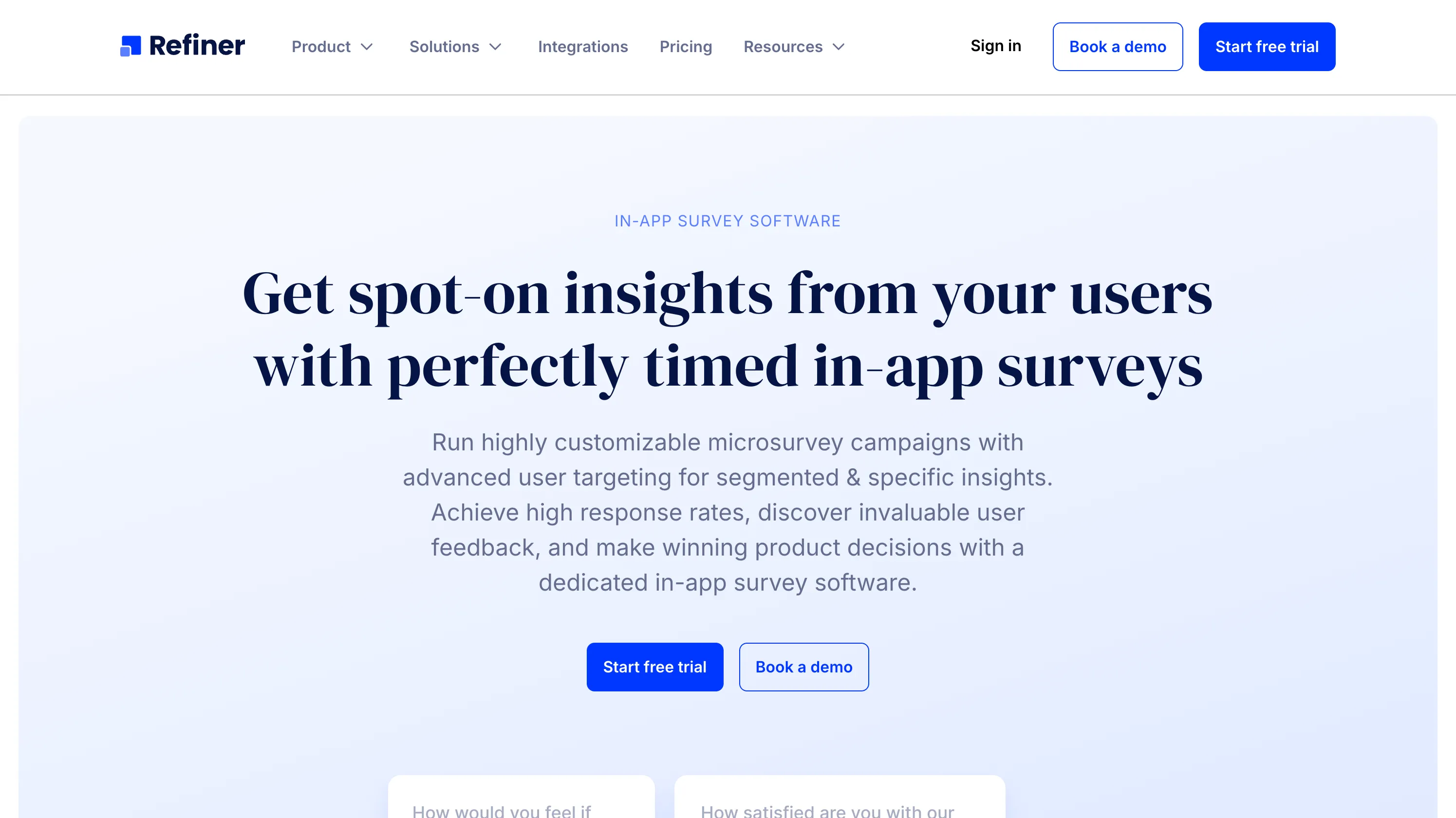
Refiner is what many product teams expect Survicate to feel like when the workflow is mostly in-app research.
Refiner’s paid plans use MAU-based pricing instead of response tiers. Paid plans include unlimited survey responses, while Growth adds event tracking plus CDP, CRM, and analytics integrations.
What Refiner does well:
- Deeper SaaS segmentation - Traits, behavior, segments, throttling, and event-triggered campaigns are central to the product.
- Broader SDK coverage - Web, iOS, Android, React Native, and Flutter make it a stronger fit than Survicate for mobile-heavy product teams.
- Unlimited responses on paid plans - If response caps are your main Survicate frustration, Refiner removes that constraint.
What Refiner doesn’t do:
The tradeoff is MAU-based pricing. Your bill rises with audience size even if survey volume stays controlled. It is also less attractive than Survicate when you need review ingestion, or a broader CX workflow in the same tool.
Choose Refiner if you run a product-led SaaS or mobile app and want deeper survey targeting than Survicate’s broader, multichannel approach.
See Refiner pricing for more details.
4. Typeform: Best for polished forms, not continuous in-product feedback

Typeform wins on design, completion experience, and shareable forms. It is relevant when your job is collecting structured feedback by link or embed, not timing surveys inside the product.
Typeform lists $39/month for 100 responses, $79/month for 1,000, and $129/month for 10,000 on monthly billing. That is straightforward, but it is still response-tier pricing inside a forms-first product.
What Typeform does well:
- Polished form experience - The one-question-at-a-time flow still looks and feels better than most survey tools.
- Strong external distribution - Links, embeds, and branded forms are easier to ship across teams.
- Familiar buying motion - Most teams already know how Typeform works, and the paid tiers are easy to understand.
What Typeform doesn’t do:
It is not a strong Survicate replacement if you care about recurring in-product targeting. Product timing, lifecycle survey orchestration, and behavioral context are all weaker. You are buying a beautiful form builder, not a SaaS feedback system.
Best when the problem is external survey presentation, not in-product timing.
5. Hotjar: Best for pairing survey answers with replay and heatmap context
Hotjar starts with behavior analytics, then adds surveys so you can ask users why they hesitated, bounced, or converted.
Hotjar is now part of Contentsquare, and the survey product sits inside a broader Voice of Customer package, where pricing starts at $99/month for 500 monthly responses, then $129/month at 1,000 and $249/month at 2,500.
What Hotjar does well:
- Behavioral context built in - Session replay and heatmaps are the real reason to buy it.
- Strong web research workflow - Exit surveys, page-level prompts, and replay-backed investigation work well together.
- AI analysis and survey reporting - Hotjar pushes harder on summaries, sentiment, and completion reporting once you are in the paid tiers.
What Hotjar doesn’t do:
Surveys are still a module inside a broader suite. If you do not need replay or heatmaps, Hotjar may be more product than the survey job requires. It is also web-first, so it is not the answer for teams leaving Survicate because they need stronger mobile coverage.
Choose Hotjar if seeing what users did matters as much as asking what they thought.
6. Pendo: Best for enterprise teams that want analytics, guides, and surveys together
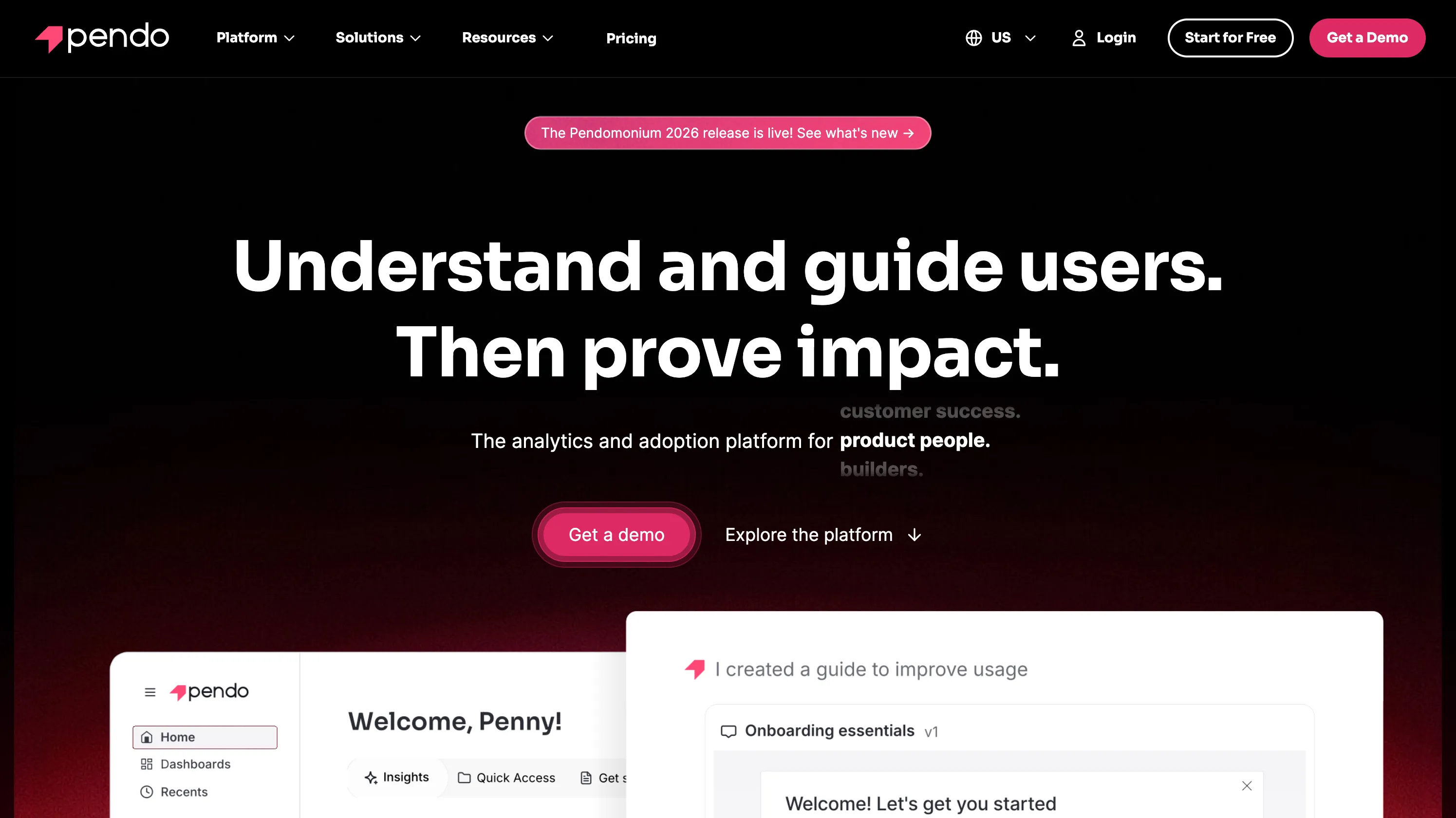
Pendo is a product experience platform where surveys sit alongside analytics, guides, and adoption tooling.
Pendo Free includes up to 500 monthly active users and Pendo-branded NPS. After that, paid plans are custom-priced and tied to MAU volume plus the bundle of capabilities you choose.
What Pendo does well:
- Product analytics first - If usage data is the real missing layer in your Survicate setup, Pendo closes that gap.
- Guides plus surveys - Onboarding prompts, in-app education, and feedback can live in one place.
- Enterprise depth - Governance, scale, and multi-platform coverage are materially stronger than Survicate’s SMB-to-mid-market feel.
What Pendo doesn’t do:
It is heavier to implement and shaped by platform complexity rather than survey speed. If your team mainly wants recurring surveys, Pendo is usually too much product and too much contract.
Right choice for larger product orgs that already need analytics and guides, not just better surveys.
7. Iterate: Best for mobile-first teams that want flexible white-label survey programs
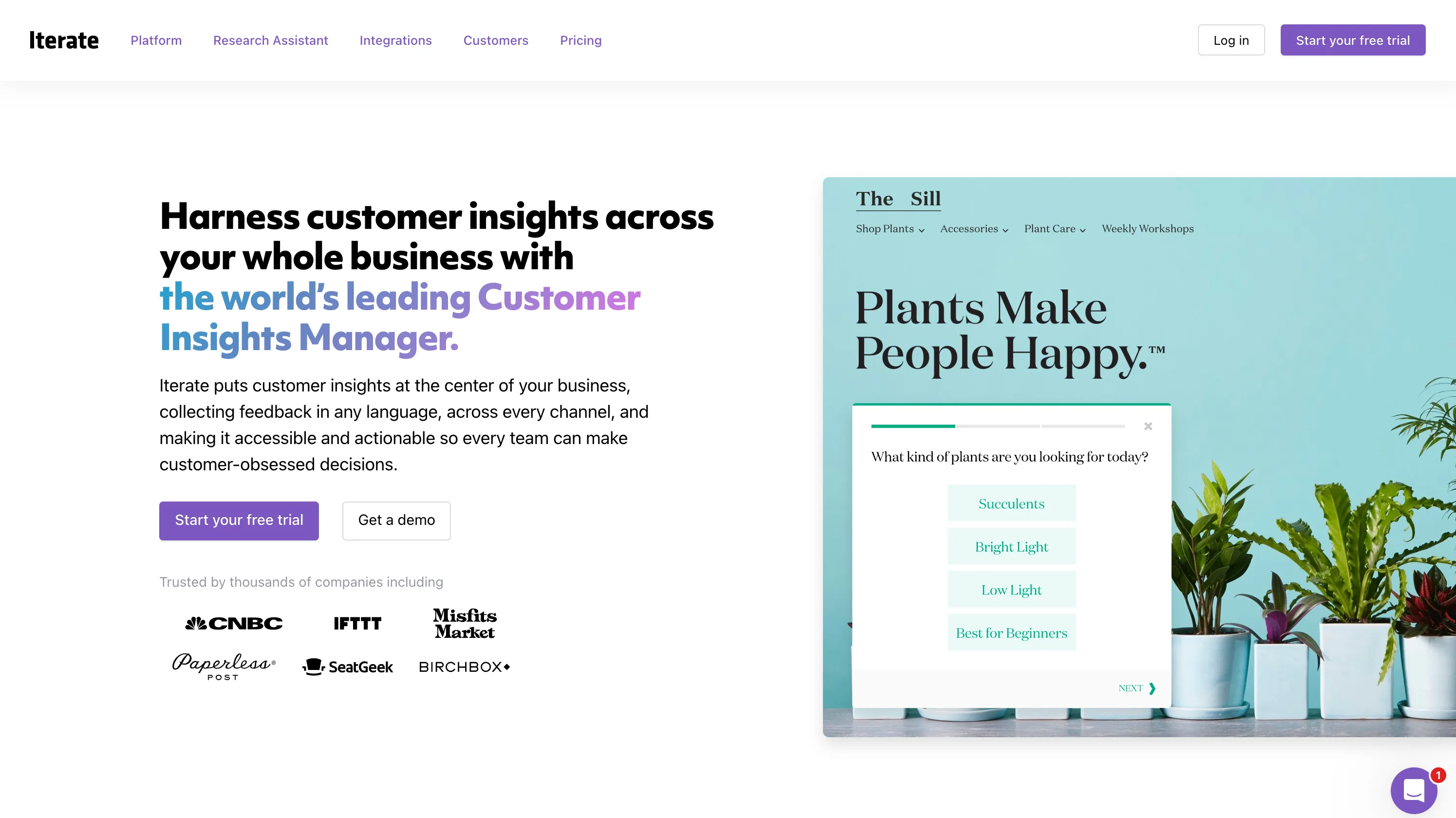
Iterate sits between Survicate’s breadth and Refiner’s SaaS focus.
Pricing is usage-based. The product scales on monthly active users, email volume, and optional add-ons like premium integrations, research assistant, and white-labeling. Paid plans include unlimited responses.
What Iterate does well:
- Mobile brand control - Strong fit when you want iOS/Android delivery and white-label presentation without buying a heavier CX suite.
- White-label flexibility - Good option for teams that care how surveys look inside the product.
- Unlimited responses with a lighter product - Less suite weight than Hotjar, Pendo, or Zonka.
What Iterate doesn’t do:
It has a smaller public review footprint than bigger vendors, and expansion pricing is harder to compare before talking to sales. Survicate also supports native mobile SDKs and still has the stronger public integration catalog, so Iterate is more of a brand-control and lightweight collection choice than a pure coverage upgrade.
Choose Iterate if mobile brand control and a lighter collection layer matter more than Survicate’s wider channel mix.
8. SurveyMonkey: Best for broad research and stakeholder familiarity
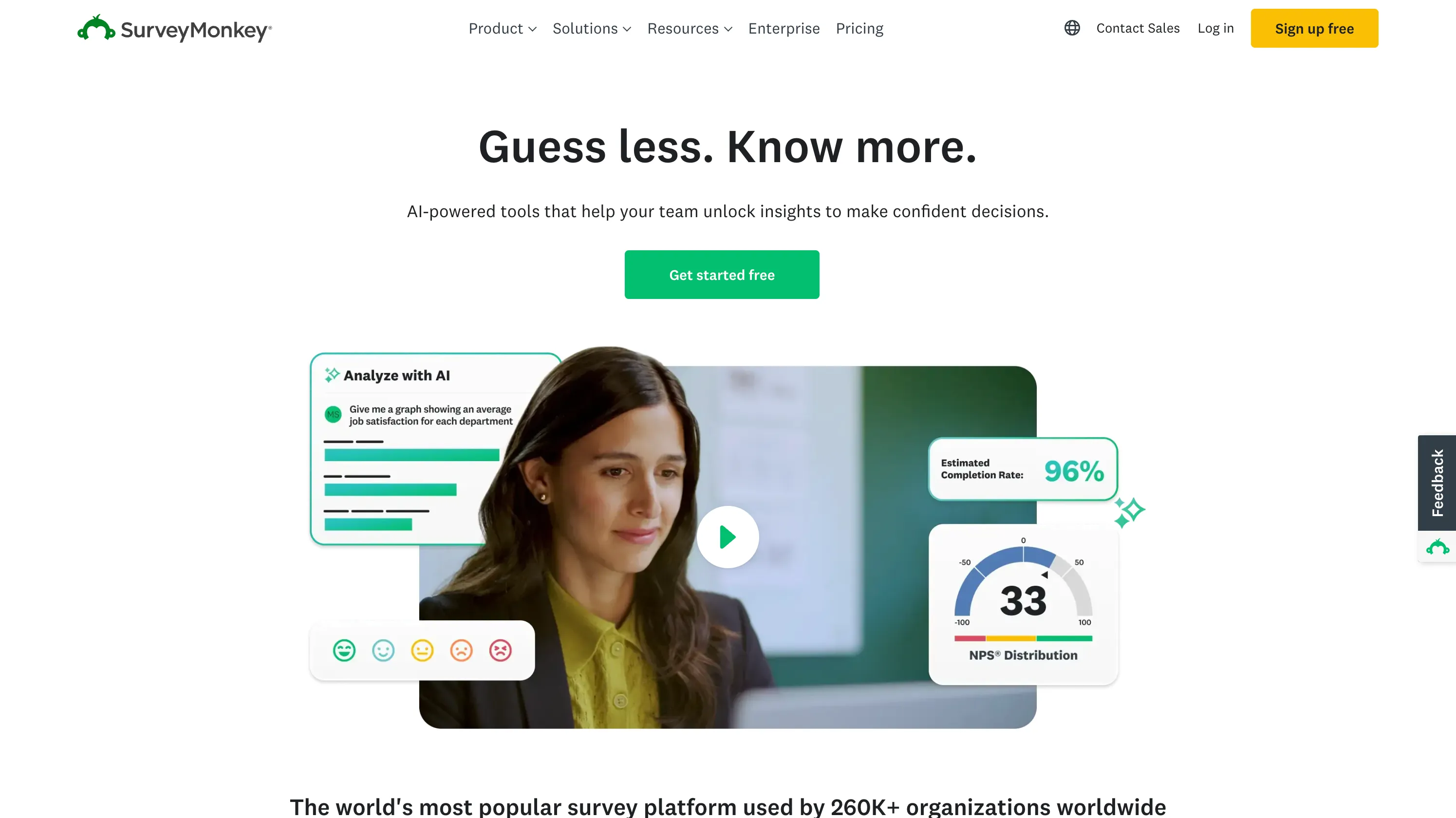
SurveyMonkey stays relevant because many teams already know it, and that still matters in larger companies.
The pricing model is not especially friendly to focused SaaS feedback teams. Team plans start at $30/user/month with a 3-user minimum billed annually, and paid plans can charge up to $0.15 per response over the limit.
What SurveyMonkey does well:
- Strong general research toolkit - Templates, analysis, exports, and enterprise familiarity are the core strengths.
- Many collection channels - Links, email, web, QR, and mobile SDK options give it broad reach.
- Team collaboration and familiarity - Easier than Survicate to justify when multiple departments need shared survey access.
What SurveyMonkey doesn’t do:
It is still a general survey platform, not a strong in-product SaaS feedback system. Per-user pricing plus overage risk also makes it easy to overpay for a job that narrower tools handle better.
Best when the buyer is standardizing broad survey operations, not building a recurring product-feedback loop.
9. Zonka Feedback: Best for enterprise omnichannel CX programs
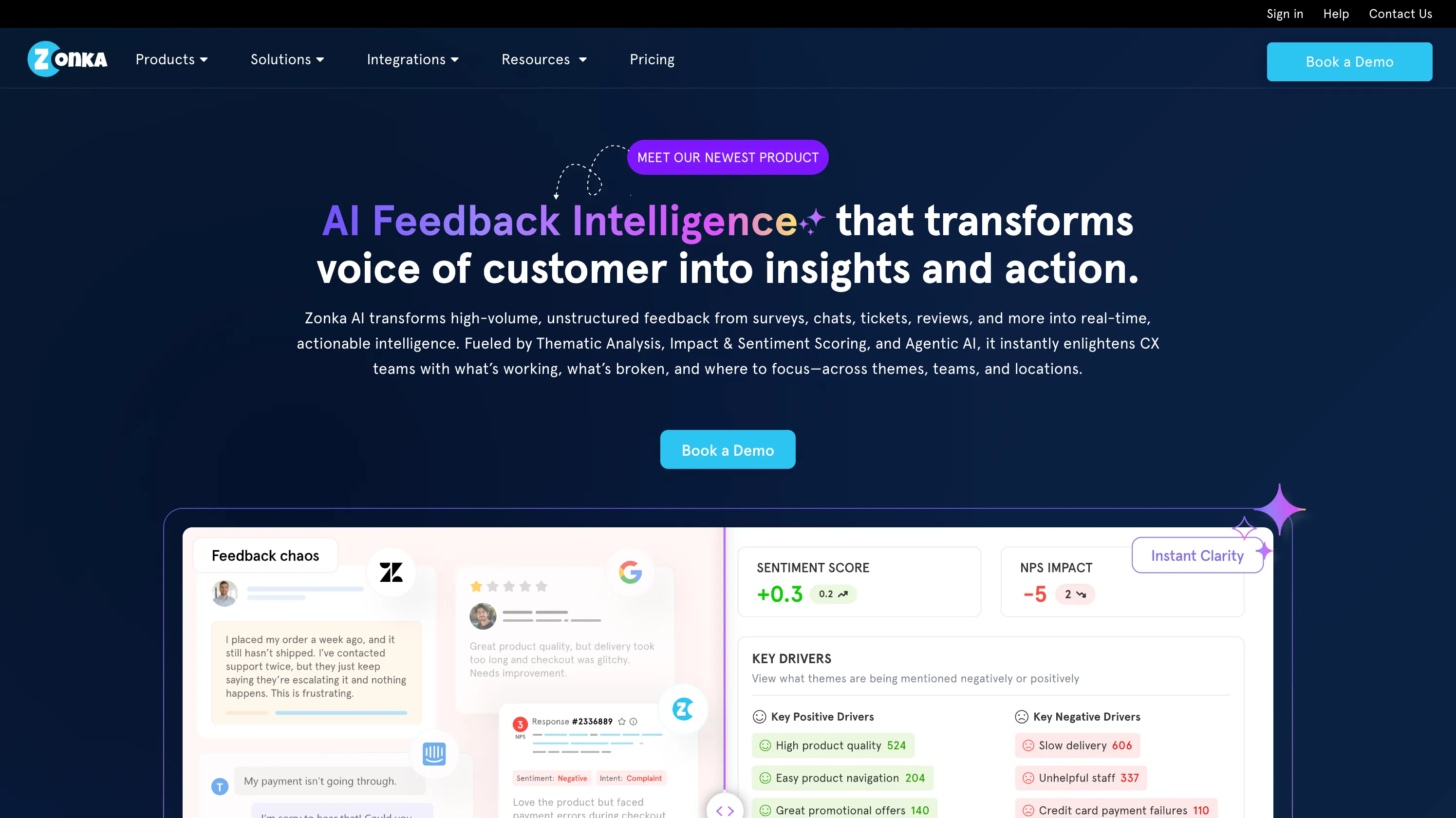
Zonka Feedback is the “more channels” option. Email, SMS, WhatsApp, offline, in-app SDKs, web surveys, and CX operations all sit inside one platform.
Zonka’s pricing is custom-quoted. The official pricing page frames Feedback Management and AI Feedback Intelligence separately, with pricing based mainly on response volume and AI data credits.
What Zonka Feedback does well:
- Real omnichannel coverage - Broader than Survicate if your program spans digital and offline touchpoints.
- CX operations depth - Alerts, case management, workflows, and role-based onboarding push it beyond a survey tool.
- Enterprise packaging - SSO, regional hosting, compliance language, and AI analysis are front and center.
What Zonka Feedback doesn’t do:
For a SaaS team that mainly wants in-product feedback, this is usually too much platform. The custom quote, broader CX posture, and heavier workflow can create more complexity than the job requires.
Good fit for larger CX programs. Overkill for most product-led SaaS teams replacing Survicate.
Why Survicate alternatives split into two very different camps
One camp is trying to be the full feedback operating system. The other is trying to solve a narrower product problem well.
The wrong move is buying more platform than your feedback program needs.
How to Choose the Right Survicate Alternative
Start with your actual problem, not a feature checklist.
If response tiers and annual pricing are the problem:
- Pulseahead - Best if you want flat monthly pricing and a focused in-product SaaS workflow.
- Qualaroo - Best if you want a cheaper website-nudge tool and can live with older product UX.
If you need sharper in-product targeting for product teams:
- Refiner - Best for deeper segmentation, event-style campaigns, and stronger mobile SDK coverage.
- Pulseahead - Best for web-first SaaS teams that want lifecycle timing rules, and user attributes.
If replay, analytics, or in-app guides are part of the decision:
- Hotjar - Best when replay and heatmaps are core to the workflow.
- Pendo - Best when you want analytics, guides, and surveys in one enterprise platform.
If the real job is not in-product feedback at all:
- Typeform - Best for polished link-based surveys and forms.
- SurveyMonkey - Best for broad research and internal stakeholder familiarity.
If you need a wider CX or omnichannel program than Survicate offers:
- Zonka Feedback - Best for enterprise feedback operations across many channels.
- Iterate - Best for mobile-first teams that want a lighter product than the big suites.
Staying on Survicate: Stay if you genuinely need one tool for web, email, links, mobile, and AI-assisted feedback analysis, and the pricing still fits your survey volume.
Bottom Line
Survicate is a broad, capable product. The reason to leave is usually not missing features. It is that the mix of pricing, tiers, and channel breadth stops matching the simpler job many SaaS teams actually need done.
Pulseahead takes the opposite approach: narrower surface area, clearer pricing, and a faster path to recurring lifecycle feedback inside the product. It is a strong answer for web-first SaaS teams that want feedback to become a habit instead of a budget line they keep second-guessing.
Try Pulseahead free and launch your first in-product lifecycle survey in under 10 minutes.
Flat pricing for SaaS feedback teams.